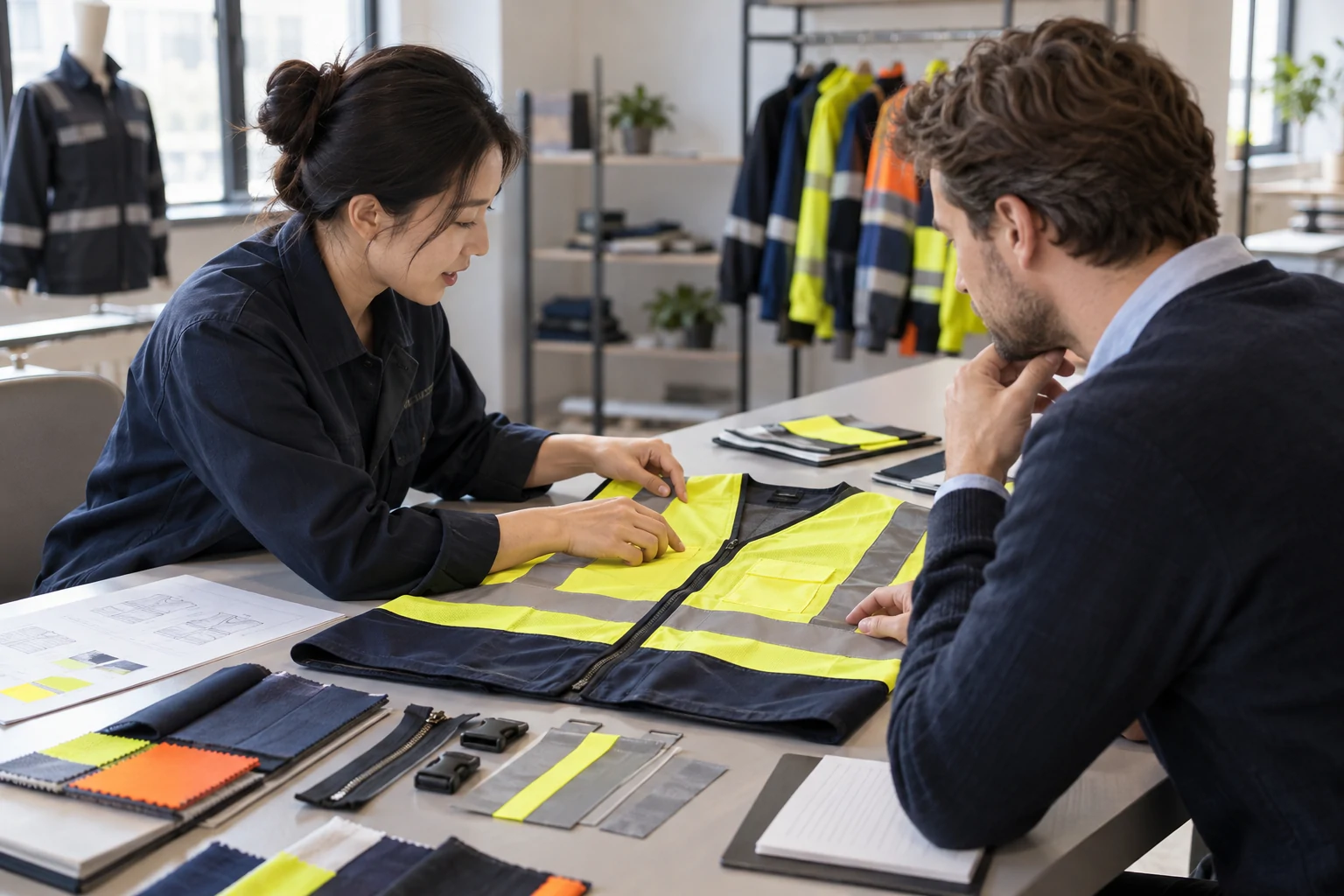
Hi-vis workwear can feel hot when the wearer's heat production and the surrounding conditions exceed what the clothing system can release. Workload, sunlight, humidity, airflow, garment structure and sweat evaporation all matter. Neither a fibre name nor the lowest GSM can tell a buyer how a finished garment will feel during the actual job.
Why hi-vis workwear can feel hot
Working muscles generate heat, while the surrounding air and sunlight add to the exposure. Humidity can limit sweat evaporation, and clothing can restrict heat loss. This is why temperature alone is an incomplete guide to occupational heat burden.
NIOSH explains that clothing and PPE can retain heat and moisture and add physical effort through their weight. A light vest over another layer, with loaded pockets and little air movement, may therefore feel uncomfortable even though its fabric looks thin.
Keep four different outcomes separate: feeling more comfortable, cooling the skin, changing core body temperature and reducing heat-related illness risk. A wearer reporting a pleasant breeze does not establish the other outcomes. Buyers should ask what was assessed, under which conditions and on which exact garment, rather than treating a comfort claim as a safety result.
Why GSM alone is not enough
GSM describes fabric mass per unit area, not a finished garment's ability to release heat. Construction, finishes, stiffness and contact with underlayers also need consideration. Compare an open mesh, a closed knit and a woven fabric as distinct constructions; do not rank them by weight alone.
Mesh may provide openings for air to pass through, but that benefit depends on the exact fabric and whether other layers or equipment block it. Solid panels can be considered where a pocket, printed logo or reinforcement needs support. Neither mesh nor solid construction is automatically the cooler or more durable choice; relevant testing and a wearing trial answer different parts of that question.
HV-V101 is a mesh-construction catalog reference for discussing a lightweight vest direction. Use it to identify the structure and closure you want to review, then request the actual material specification for your sample. A catalog photograph does not establish composition, fabric weight, air permeability or durability.
The brief also needs priorities. Low garment weight, large decorated areas, multiple loaded pockets, radio storage and a structured appearance can pull the design in different directions. Agree where support is necessary and where an open construction could be evaluated, instead of asking one fabric to solve every requirement.
Fabric breathability versus whole-garment airflow
A material swatch is not a finished vest or jacket. Pockets, closures, binding, reflective trim, reinforcement and logos change the assembled structure. Radios, tools and underlayers change the clothing system again. Review airflow with the garment worn and equipped as it will be used.
A solid front with ventilation panels at the sides or back is one design route to evaluate, not a guarantee of comfort. Check whether the openings remain useful when the wearer sits, bends, reaches or carries equipment. A large print across a mesh panel may defeat the reason for selecting that panel.
Reflective-material choices belong in the same review. If segmented trim is proposed, ask about the exact material's flexibility, application method and airflow characteristics, as well as the effective reflective area and layout required by the applicable standard. These are checks to make, not properties established by a segmented appearance.
Changing a panel, background colour, pocket, logo or reflective layout can change the finished configuration. Confirm the required visibility documentation for that configuration. An image or material file alone does not establish a garment classification, and a design change does not automatically inherit one.
Passive ventilation: start with the garment design
Within garment development, review passive airflow before adding powered components. Look for unnecessarily blocked panels, unsuitable underlayers, excessive pocket loading and fit that prevents useful air movement. Consider targeted mesh or ventilation panels without removing protection that the task requires.
This design sequence is not the hierarchy for controlling workplace heat risk. OSHA prioritises reducing the heat hazard and adjusting how work is performed. NIOSH also identifies workplace controls, hydration, suitable rest and recovery, and acclimatization. A garment discussion must sit within that broader plan, not replace it.
OSHA — Engineering Controls, Work Practices and PPENIOSH — Workplace Recommendations
Keep required PPE in the wearing trial. Check movement and coverage with the actual shirt, harness, belt and other equipment. Do not open closures, omit layers or remove necessary protection simply to make an airflow demonstration look better.
Fan-assisted airflow: assess the exact system
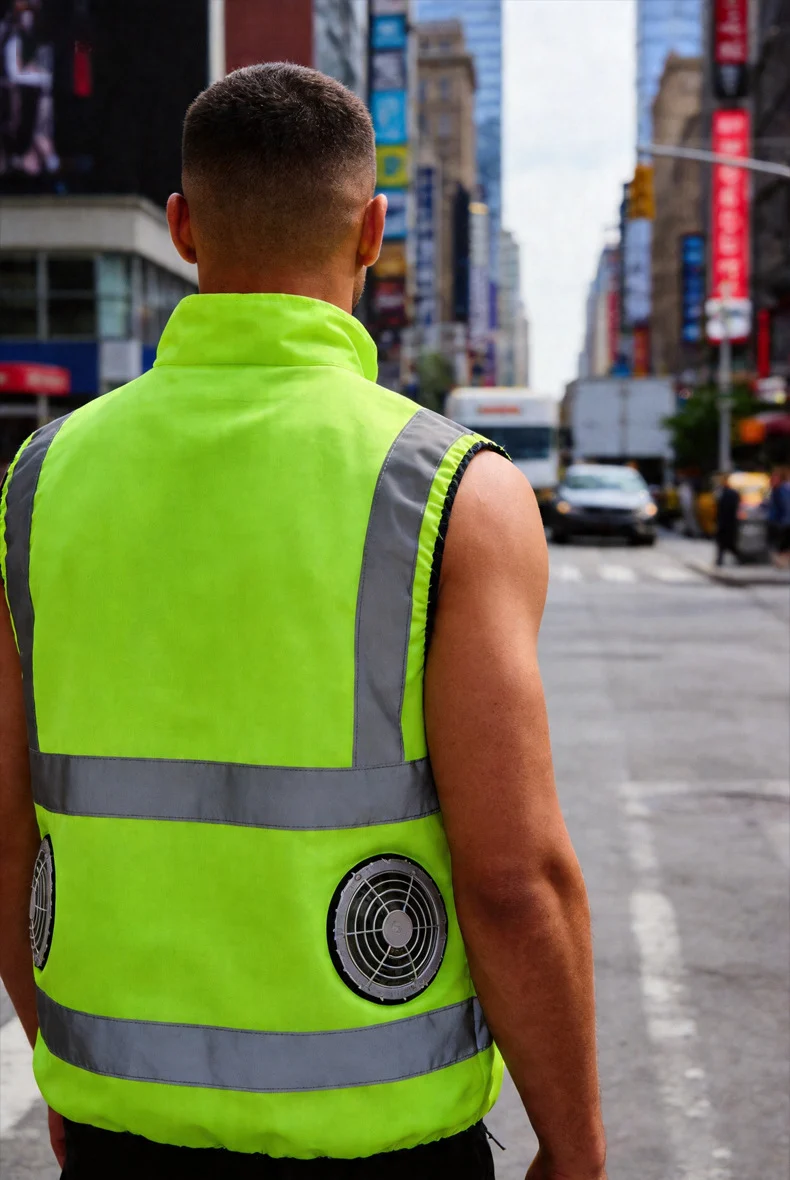
Ordinary garment fans move ambient air; they are not refrigeration equipment. Their usefulness depends on temperature, humidity, sweat evaporation, airflow paths, workload and the complete system. Do not assume that a fan-equipped vest will be effective or suitable in every environment.
NIOSH discusses several personal cooling systems, with different operating principles and practical limitations. That guidance is not a test of the portable fan vest pictured here. Likewise, OSHA's example of a vest supplied with cooled compressed air describes a different system, not evidence for a small battery-powered fan garment.
NIOSH — PPE Heat BurdenOSHA — Engineering Controls, Work Practices and PPE
In a prototype, map where air enters, where it can travel and where it exits. Check internal space with the expected layers, and whether a seated posture or loaded pockets obstruct the path. Review fan and battery positions during bending, sitting and tool use, alongside reflective layout and compatibility with required PPE.
Ask for evidence matched to the garment, cooling components and conditions. Separate subjective comfort feedback from measured skin or core-temperature outcomes. Without suitable evidence, do not specify a promised temperature reduction, battery duration or prevention of heat illness. Appearance does not establish visibility or flame-resistance certification.
Compare three design approaches
Use this comparison to organise sample questions, not to declare a universally best construction. Each route needs review against the intended task and finished configuration.
| Design approach | What it may help with | What buyers must verify |
|---|---|---|
| Mesh construction | Providing openings for passive airflow where they remain unobstructed. | Exact fabric, underlayers, pocket and logo coverage, wear requirements and finished visibility configuration. |
| Solid construction with ventilation panels | Placing support and potential ventilation in different areas of the garment. | Panel positions, openings during movement, finish or coating, pocket loads and applicable documentation. |
| Fan-assisted airflow | Moving ambient air through a planned internal pathway. | Conditions and test evidence, entry and exit paths, battery and fan placement, maintenance and worksite suitability. |
What buyers should specify
Replace a brief such as 'we need a breathable safety vest' with a description of the job and the complete clothing system. Use the following points when preparing a sample request or comparing proposed designs.
- Environment and work intensity: temperature, humidity, sunlight or radiant heat, air movement, task demands and time in the work area.
- Layers and equipment: the shirt and other PPE, harness or belt, radios, tools, tablets and realistic pocket loads.
- Structure and fit: areas needing support, pocket access, ventilation-panel positions and room for movement without compromising coverage.
- Visibility requirements: target market, required standard and finished configuration, including decoration and reflective layout.
- Care: the exact garment's washing, drying and storage requirements, and how trim, finishes or decoration affect them.
- Fan-system review where relevant: power source, battery and fan positions, acceptable total weight, removal for cleaning, maintenance, dust exposure and any special worksite restrictions.
- Sample approval: record the materials, fit, loaded-pocket trial, component versions, care instructions and evidence needed before a production decision.
A useful brief is more than a fabric request
Hot-weather workwear selection is a garment and workplace problem, not a race to the lowest GSM. Identify where the clothing system may trap heat and moisture, put support where the job needs it, and assess proposed airflow routes on a realistic sample.
A fan concept is one possible direction to evaluate, not an automatic solution or a confirmed catalog offering. Bring the intended environment, layers and equipment to the discussion. Physical sample review, product-specific evidence and the worksite heat-risk plan should guide the next decision.
Discuss your hot-weather workwear requirements
Share the working conditions, garment direction and sample questions you need to resolve. Use the existing inquiry form to start the discussion.
Discuss the requirements