Choose mesh when heat, airflow and low weight lead the brief and the vest carries little. Choose solid knit or woven fabric when pockets hold radios, tablets or tools, when a large logo needs a stable surface, or when snagging and abrasion are concerns. Many programs issue both: a mesh vest for general crews and a solid surveyor-style vest for supervisors and survey teams. Either can meet a high-visibility class; the finished garment decides.
Mesh and solid vests compared
The fabric changes comfort, storage and decoration more than visibility. Use this comparison as a starting point for each role.
| Factor | Mesh | Solid knit or woven |
|---|---|---|
| Airflow | High | Lower |
| Weight | Light | Heavier |
| Pocket support | Light items | Radios, tablets, tools |
| Logo surface | Limited | Print, embroidery, patches |
| Snag resistance | Lower | Higher |
| Typical roles | General crews, hot sites | Surveyors, supervisors |
When does mesh make sense?
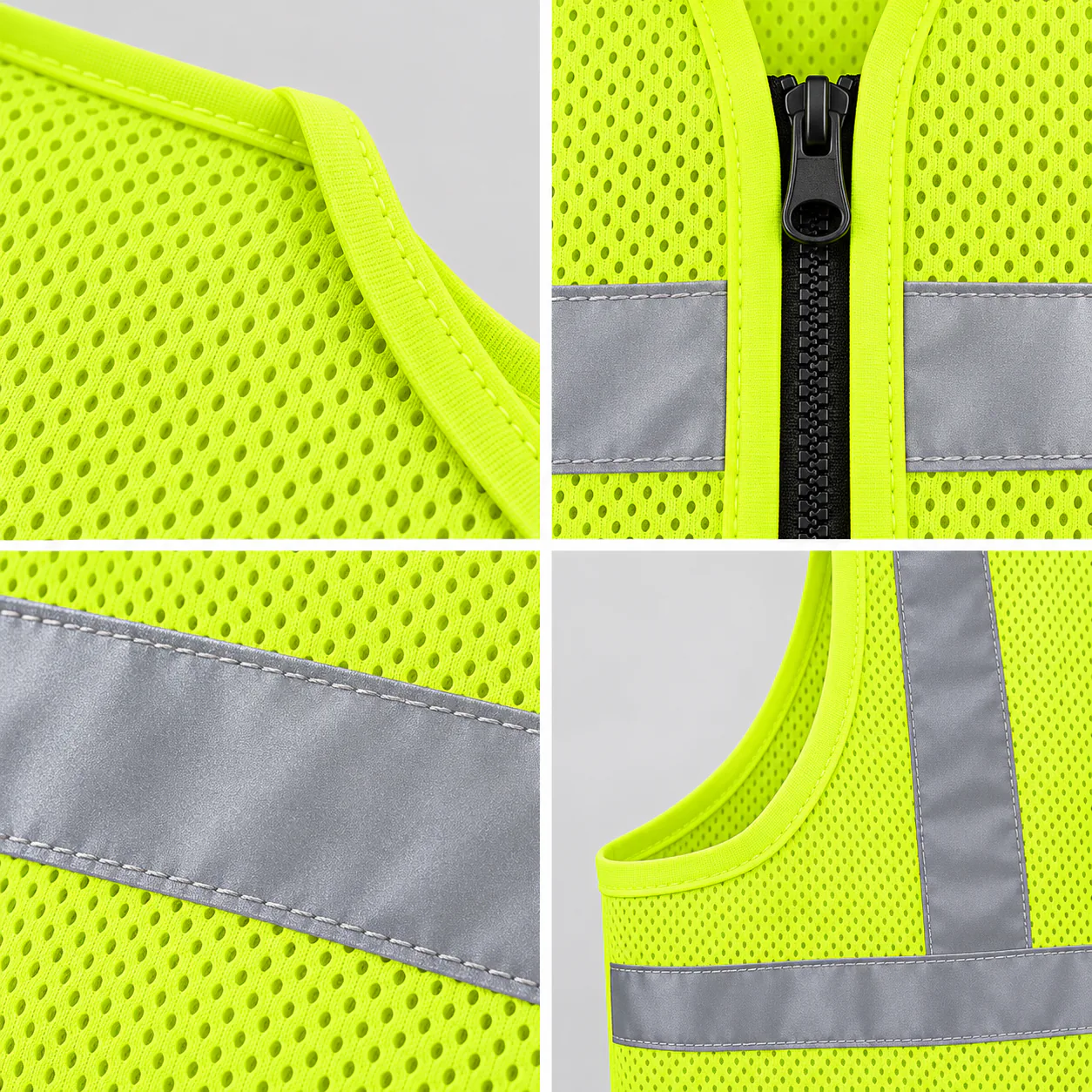
Mesh suits hot climates, long shifts in the sun and tasks where the vest carries an ID badge and a phone at most. Open construction lets air move and keeps weight down; the HV-V101 economy vest, for example, uses 110–130 GSM mesh. Mesh does not make a vest cool on its own. Fit, the layers underneath and the work rate all change comfort. Check that the mesh keeps its shape at pocket openings and armholes after washing, and that the edge binding does not curl.
When does solid fabric make sense?
Solid knit or woven fabric holds its shape under load, so pockets carrying radios, tablets, tape measures or field books stay closed and in place. It gives screen print, embroidery and woven patches a stable surface, resists snagging on rebar, wire and sharp edges, and blocks some wind in cooler weather. The trade-off is heat: a solid vest over a work shirt holds more warmth in summer. Surveyor-style vests such as the HV-V212 use solid fabric for these reasons.
Hybrid vests
Hybrid designs combine a solid front, where pockets and logos sit, with mesh back or side panels for airflow. They suit supervisors and surveyors in warm climates who still need storage. Check that the seams between mesh and solid panels are reinforced, that the retroreflective tape crosses them cleanly, and that the solid areas do not cut airflow more than the brief allows. Confirm the class on the finished hybrid, because panel changes move the counted areas.
Breakaway vests near moving equipment
Breakaway vests separate at the shoulders and sides when pulled, so a vest caught on machinery, a vehicle mirror or equipment releases instead of dragging the wearer. The HV-V305 uses a five-point design. Check that the release points open with a firm pull and reattach easily, that loaded pockets do not pull them open by accident, and that logos and tape do not bridge the release seams. Approve the release behavior on a physical sample.
Will either fabric meet the required class?
Mesh and solid fabric can both serve as fluorescent background material when they are a recognized color. The class depends on the finished garment: background and retroreflective areas, tape width and layout, and coverage in each size. Under ANSI/ISEA 107, Class 2 needs at least 775 in² of background and 201 in² of retroreflective material, and a vest alone cannot be Class 3. Pockets in non-fluorescent material, dark binding and large logos reduce the counted area, so check the smallest size ordered.
Plan the logo with the fabric
Decoration options depend on the surface, so decide the logo before the fabric is fixed.
- Mesh: use heat transfers suited to open mesh; screen ink and embroidery have little to grip.
- Solid fabric: screen print, embroidery, transfers and woven patches are all possible.
- Large back logos: choose a solid vest or a solid back panel.
- Keep every logo on background fabric, clear of retroreflective bands and release points.
- Approve the logo size on the smallest vest in the range.
Questions to settle before choosing
Answer these for each role before you request samples. The answers usually make the fabric choice obvious.
- Climate, shift length and work rate.
- What each wearer carries and where it must be reached.
- The standard, type and class from the employer's hazard assessment.
- Logo method, size and placement.
- Whether release points are needed near equipment.
- The laundering route and expected service life.
Common questions
Is a mesh safety vest less safe than a solid one?
Not by itself. Mesh and solid fabric can both provide fluorescent background in a recognized color. Visibility depends on the finished garment's background and retroreflective areas, tape layout and fit. A mesh vest that meets its class is as visible as a solid one; choose by climate, load and decoration.
Are mesh vests cooler than solid vests?
Usually, because open mesh lets air through and weighs less. Comfort still depends on the shirt underneath, fit and work rate. In hot weather, pair a mesh vest with a breathable shirt, or consider a sleeved hi-vis shirt where the job calls for Class 3.
Can you print a logo on a mesh vest?
Yes, with a heat transfer suited to open mesh. Screen ink and embroidery have little surface to grip on mesh. For a large logo, choose a vest with a solid printable panel. Keep the logo clear of retroreflective bands and confirm the finished vest still meets its class.
What is a breakaway safety vest for?
A breakaway vest separates at the shoulders and sides when pulled, so it releases if caught by machinery, vehicles or equipment instead of dragging the wearer. Check the release force, reattachment and that loaded pockets or logos do not stop the vest from separating.
Sources and further reading
ISEA: ANSI/ISEA 107-2020 high-visibility safety apparelConstruction buyer discussion: vest qualityConstruction wearer discussion: hot-weather fabricTurn the guide into a product brief.
Choose a product or send the requirement that still needs a recommendation.
Explore workwear