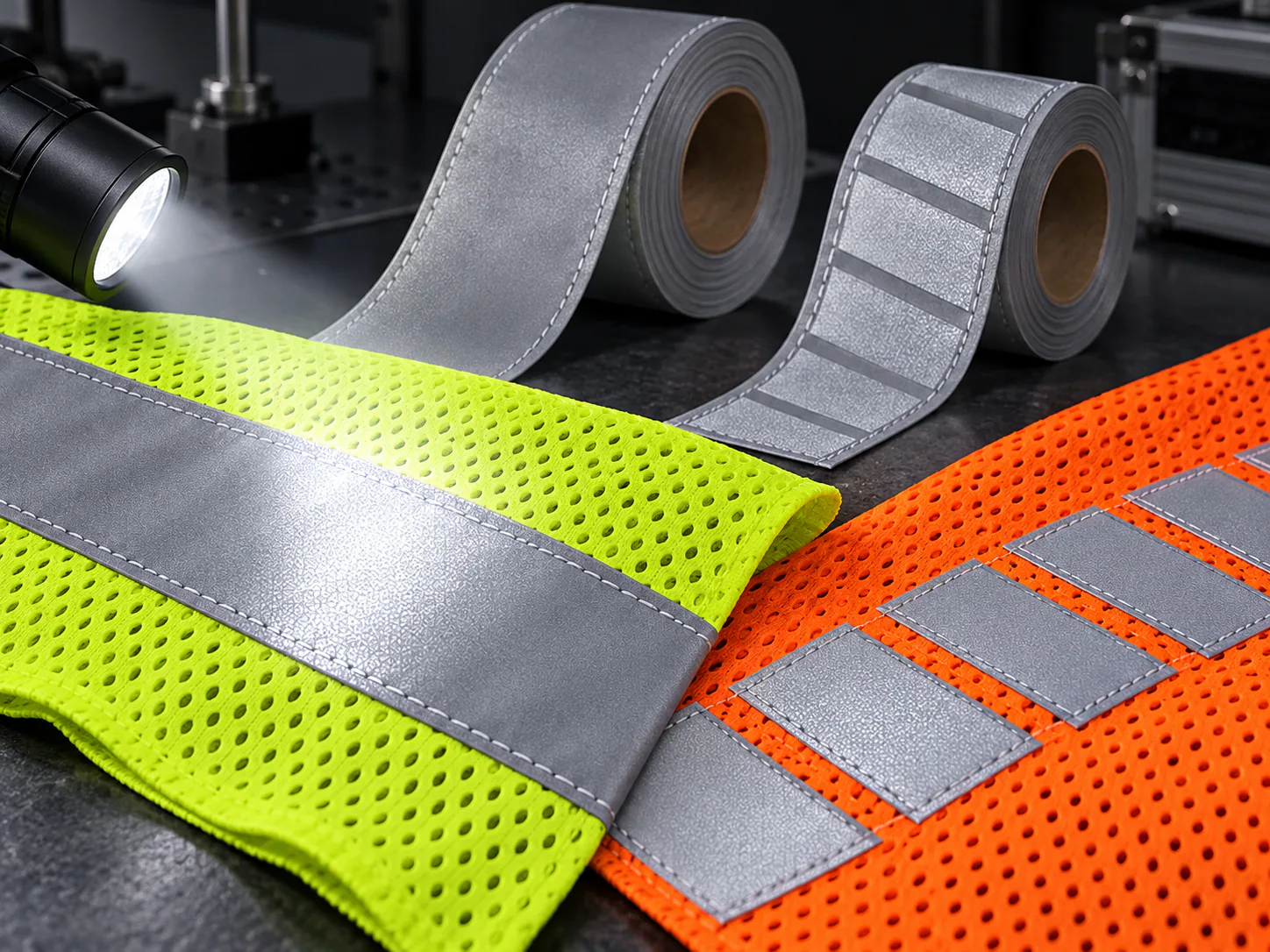
Fluorescent material makes a worker stand out in daylight and at dusk by converting part of the incoming light, including ultraviolet, into brighter visible color. Retroreflective material sends light from headlights or lamps back toward its source, so it works in the dark. High-visibility standards require minimum areas of both. ANSI/ISEA 107 Level 2 material and new EN ISO 20471 retroreflective material must reach at least 330 cd/(lx·m²) at the standard test angles.
How does fluorescent material work?
Fluorescent dyes absorb part of the light that falls on them, including ultraviolet light the eye cannot see, and re-emit it as visible color. The fabric looks brighter than ordinary colors around it, which helps in daylight, at dawn and dusk, and in overcast weather. Fluorescence depends on ambient light, so in darkness it adds little on its own. Fabric caught in headlights scatters light in all directions, and only a small share returns to the driver. Standards therefore treat fluorescent fabric as background material, the large daytime area of the garment.
How does retroreflective material work?
Retroreflective material returns light toward its source instead of scattering it. Glass-bead tape does this with tiny glass spheres; microprismatic tape uses molded prism structures. Because the light comes back in a narrow cone, a driver just behind the headlights sees the tape shine, while someone standing off to the side sees far less. The material does not emit light. It needs a source aimed at it, such as headlights, a lamp or a work light, and a viewer close to that source. In daylight, silver tape looks gray and adds little contrast.
Fluorescent and retroreflective material compared
The two materials answer different light conditions. Use this comparison when reviewing a sample or a specification.
| Factor | Fluorescent | Retroreflective |
|---|---|---|
| Main job | Daytime contrast | Night recognition |
| Works best in | Daylight, dusk | Dark, when lit |
| Returns light | In all directions | Back to the source |
| Typical form | Fabric, mesh, knit | Tape, transfers, trim |
| Reduced by | Sunlight, bleach, wear | Abrasion, soiling, heat |
| ANSI Class 2 minimum | 775 in² | 201 in² |
| EN ISO 20471 Class 2 | 0.50 m² | 0.13 m² |
What does 330 cd/(lx·m²) measure?
Retroreflective performance is expressed as a coefficient of retroreflection: the light a material returns toward a viewer for each unit of light falling on it, per square meter. ANSI/ISEA 107 Level 2 material and new EN ISO 20471 material must reach at least 330 cd/(lx·m²) at a 0.2° (12′) observation angle and a 5° entrance angle. The entrance angle describes how directly light strikes the material. The observation angle is the small angle between the light source and the viewer’s eye, seen from the garment. A value for new tape does not describe a worn garment.
Why standards require both materials
Light changes through a shift, so a high-visibility garment has to work in daylight, at dusk and in the dark. ANSI/ISEA 107 and EN ISO 20471 therefore set separate minimum areas for fluorescent background material and for retroreflective material, and both minimums rise with the class. Australia and New Zealand build the light condition into the class name: AS/NZS 4602.1:2011 uses classes D (day), N (night) and D/N (day and night). In every system, the employer’s hazard assessment decides which light conditions the garment must cover.
What is combined-performance material?
Some trims are both fluorescent and retroreflective, such as a fluorescent-colored tape with a retroreflective surface. ANSI/ISEA 107 calls this combined-performance material. In a Class 1 garment, the 155 in² minimum can be met with retroreflective or combined-performance material, alongside at least 217 in² of background material. Combined-performance trim also adds daytime color to a band that would otherwise look gray. Before relying on it in a layout, confirm how the target standard counts it for the class you are ordering.
What reduces performance over time?
Both materials lose performance with use, but for different reasons. Inspection should cover each one.
- Sunlight: ultraviolet exposure gradually fades fluorescent color.
- Laundering: bleach, harsh detergents and routes outside the care label fade color and wear tape.
- Abrasion: harnesses, tool belts and carried loads scuff the retroreflective surface.
- Contamination: oil, grease, paint and grime cover both materials and block returned light.
- Heat: high dryer settings, ironing and hot surfaces can crack tape or lift heat-applied trim.
- Cleaning cycles: EN ISO 20471 garments carry a manufacturer-stated maximum number of cleaning cycles.
Review both on the finished garment
A tape data sheet or fabric swatch describes one component. The class depends on the finished garment: background area after pockets, logos and dark panels, tape width and placement, and coverage in every size ordered. At Safvero, a digital color preview is a direction only, and production color and any classification are approved on a physical sample. Changing color, material, tape layout, pockets or logo placement means the finished configuration must be reviewed again. Keep the approved sample and specifications together, so later substitutions are visible.
Common questions
Does fluorescent fabric work at night?
Only weakly. Fluorescent fabric relies on ambient light, so in darkness it adds little conspicuity. Under headlights it scatters light in all directions, and little returns to the driver. Night visibility comes from retroreflective material, which sends light back toward its source. Garments for night work need both materials in the right areas.
Does reflective tape glow in the dark?
No. Retroreflective tape is not a light source. It returns light from headlights, lamps or work lights toward that source, so it appears to shine only to a viewer near the light. Glow-in-the-dark material works differently and is not what the retroreflective minimums in ANSI/ISEA 107 or EN ISO 20471 measure.
Is a reflective vest visible in daylight?
Mainly through its fluorescent background. Silver retroreflective tape looks gray in daylight and adds little contrast, so daytime conspicuity comes from fluorescent yellow-green, yellow, orange-red or red fabric. A dark vest with reflective tape can help at night but lacks the fluorescent background area that high-visibility classes require.
Can reflective tape turn a regular work shirt into hi-vis clothing?
Not on its own. ANSI/ISEA 107 and EN ISO 20471 classes also require minimum areas of fluorescent background material in specified colors, plus rules on where the tape sits. Tape on a dark shirt can add night visibility, but the employer’s hazard assessment decides whether that is enough for the task.
Sources and further reading
ISEA: ANSI/ISEA 107-2020 high-visibility safety apparelISO 20471 overviewEU-OSHA OSHwiki: reflective clothingTurn the guide into a product brief.
Choose a product or send the requirement that still needs a recommendation.
Explore workwear