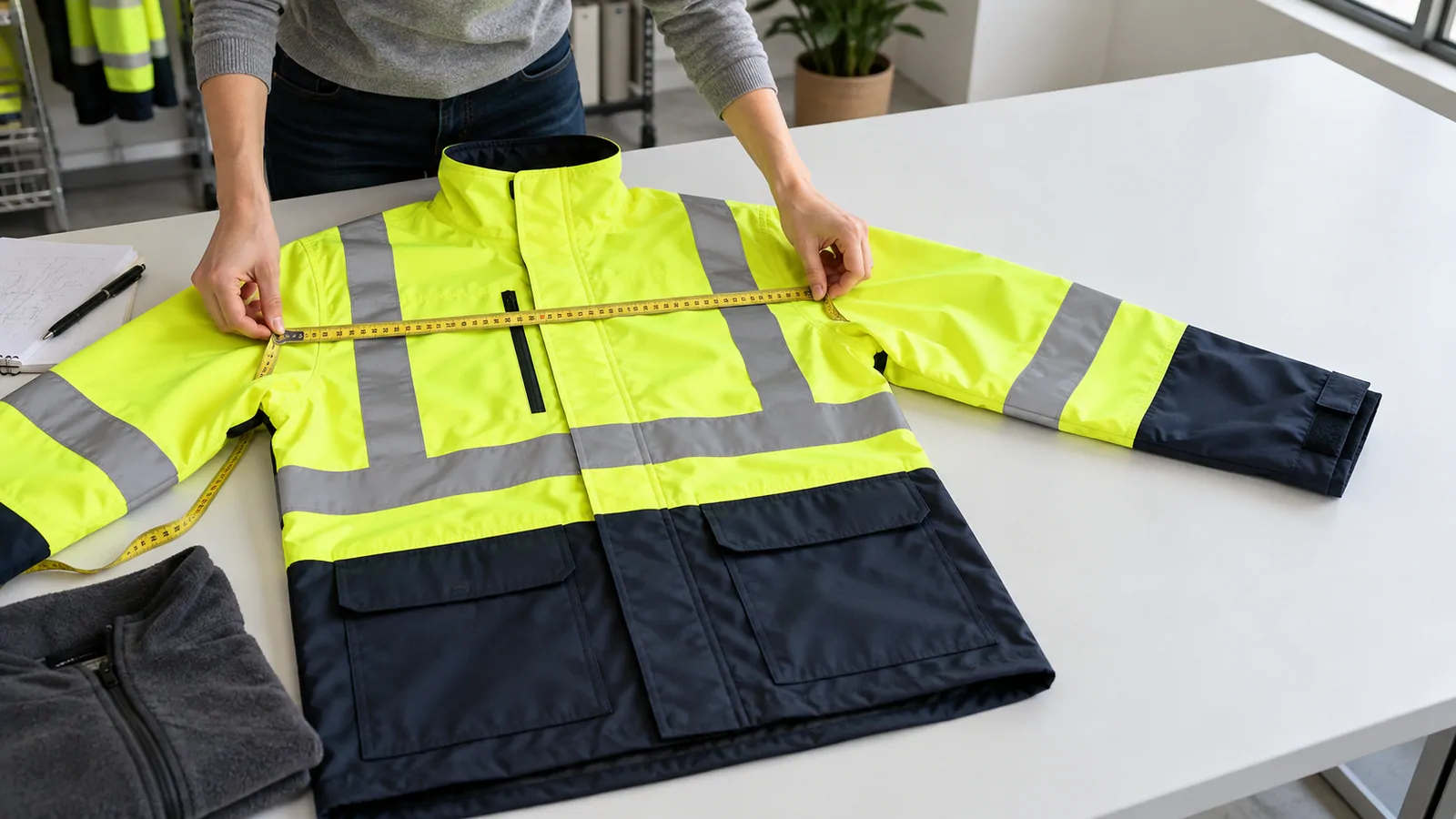
OSHA, the MUTCD and ANSI/ISEA 107 do different jobs. OSHA requires employers to assess hazards and provide personal protective equipment (PPE) of safe design that properly fits each worker. The MUTCD requires ANSI/ISEA 107 Class 2 or 3 apparel for workers within the right-of-way in a temporary traffic control (TTC) zone, and OSHA’s flagger rule points to it. ANSI/ISEA 107 defines the garment itself: type, class, material areas, colors and labels.
How OSHA, the MUTCD and ANSI fit together
Each document answers a different question. Start with the work, then check which rules apply to it.
| Document | Covers | What it sets |
|---|---|---|
| 29 CFR 1910.132 | General industry | Hazard assessment, PPE selection |
| 29 CFR 1926.95(c) | Construction | Safe design, proper fit |
| 29 CFR 1926.201(a) | Flaggers | Garments per MUTCD Part 6 |
| MUTCD Section 6C.05 | Workers in TTC zones | Class 2 or 3 apparel |
| ANSI/ISEA 107-2020 | The garment | Type, class, areas, labels |
What OSHA requires of the employer
In general industry, 29 CFR 1910.132 requires employers to assess workplace hazards, select PPE to match them and certify the assessment in writing. Employers generally pay for the PPE they require. In construction, 29 CFR 1926.95(c), effective January 13, 2025, requires PPE of safe design and construction for the work, selected to properly fit each affected employee. Fit matters for high-visibility apparel. A vest that rides up, hangs open or sits under a jacket shows less of its material. Plan a size range that covers the whole crew, including smaller and women’s sizes, worn over the layers used on the job.
Where the MUTCD comes in
OSHA’s signaling rule, 29 CFR 1926.201(a), says flagger signaling, including the warning garments flaggers wear, must conform to Part 6 of the Manual on Uniform Traffic Control Devices (MUTCD). The MUTCD itself reaches beyond flaggers. Section 6C.05 of the 11th Edition says all workers within the right-of-way in a TTC zone, including emergency responders, shall wear ANSI/ISEA 107 Performance Class 2 or 3 apparel. The background must be fluorescent orange-red, fluorescent yellow-green or a combination. Flaggers should wear Class 3 at night. Firefighters exposed to flame, heat or hazardous materials may wear retroreflective turnout gear instead. OSHA has also issued an interpretation on high-visibility apparel in work zones.
Type O, R and P explained
ANSI/ISEA 107-2020 sorts garments by where they are worn, then by performance class. Type P is equivalent to the former ANSI/ISEA 207.
| Type | Typical setting | Classes |
|---|---|---|
| O (off-road) | Warehouses, parking areas | Class 1 only |
| R (roadway) | Rights-of-way, TTC zones | Class 2 or 3 |
| P (public safety) | Emergency responders, law enforcement | Class 2 or 3 |
Is ANSI/ISEA 107 a legal requirement?
Not on its own. ANSI/ISEA 107 is a voluntary consensus standard, first published in 1999. It becomes mandatory when a regulation, agency or contract references it, as the MUTCD does for TTC zones. The standard defines garment types, performance classes, minimum material areas, background colors and labeling. The 2020 edition added criteria for single-use disposable coveralls and an option to measure nighttime luminance. Garment labels identify the standard, the garment type and the performance class. The standard does not decide which class a crew needs. That comes from the rule, contract or hazard assessment that applies to the job.
Who decides which class a crew wears?
The employer decides, through the hazard assessment, within any floor set by the MUTCD, an agency or a contract. A garment supplier does not choose the class. It builds the garment to the type and class the buyer specifies, and the finished configuration is confirmed for that order. Factors that shift the decision include traffic speed and volume, light level and shift timing, weather, background clutter, distance from moving vehicles and tasks that hold the worker’s attention. Record the decision and the reason for it, so later orders follow the same requirement rather than a remembered catalog name.
What the purchase specification should state
A clear specification lets every supplier quote the same garment and lets the receiving team check it.
- Standard and edition: ANSI/ISEA 107-2020.
- Garment type (O, R or P) and performance class.
- Background color allowed on site, plus tape color and layout.
- Size range, including the smallest size and women’s fits.
- Logo method, position and maximum size.
- Label content and documents expected for the finished garment.
Treat custom changes as a new configuration
Custom programs change the garment that was reviewed. A new body color, fabric, tape layout, pocket or logo position means the finished configuration must be reviewed again before anyone relies on an earlier class. A digital color preview shows direction only. Production color and any classification are approved on a physical sample. At Safvero, customization covers fabric and color, reflective tape, pockets, closures and hardware, logo methods, labels and packing. Record each change in the written specification.
Common questions
Does OSHA require ANSI Class 2 or Class 3 vests?
For construction flaggers, 29 CFR 1926.201(a) requires warning garments that conform to Part 6 of the MUTCD. The MUTCD requires ANSI/ISEA 107 Class 2 or 3 apparel for workers within the right-of-way in temporary traffic control zones. For other work, the employer’s hazard assessment decides which PPE is needed.
Who pays for high-visibility safety vests?
In general industry, OSHA’s PPE standard, 29 CFR 1910.132, requires employers to assess hazards and select PPE, and employers generally pay for the PPE they require. Check the OSHA standard, contract and site rules that apply to the specific work.
Is ANSI/ISEA 107 mandatory?
Not by itself. ANSI/ISEA 107 is a voluntary consensus standard. It becomes mandatory when a regulation, agency or contract references it. The MUTCD does this for workers within the right-of-way in temporary traffic control zones, who must wear Performance Class 2 or 3 apparel.
Can fluorescent red hi-vis be worn in a highway work zone?
Check the site rule first. ANSI/ISEA 107 allows fluorescent red background, but the MUTCD names fluorescent orange-red, fluorescent yellow-green or a combination for temporary traffic control zones. A fluorescent red garment can carry an ANSI class and still fall outside the work-zone color rule.
Sources and further reading
OSHA 29 CFR 1910.132: general requirements for PPEOSHA 29 CFR 1926.95: criteria for personal protective equipmentOSHA 29 CFR 1926.201: signaling and flaggersFHWA Manual on Uniform Traffic Control Devices (MUTCD)ISEA: ANSI/ISEA 107-2020 high-visibility safety apparelOSHA work-zone high-visibility interpretationTurn the guide into a product brief.
Choose a product or send the requirement that still needs a recommendation.
Explore workwear