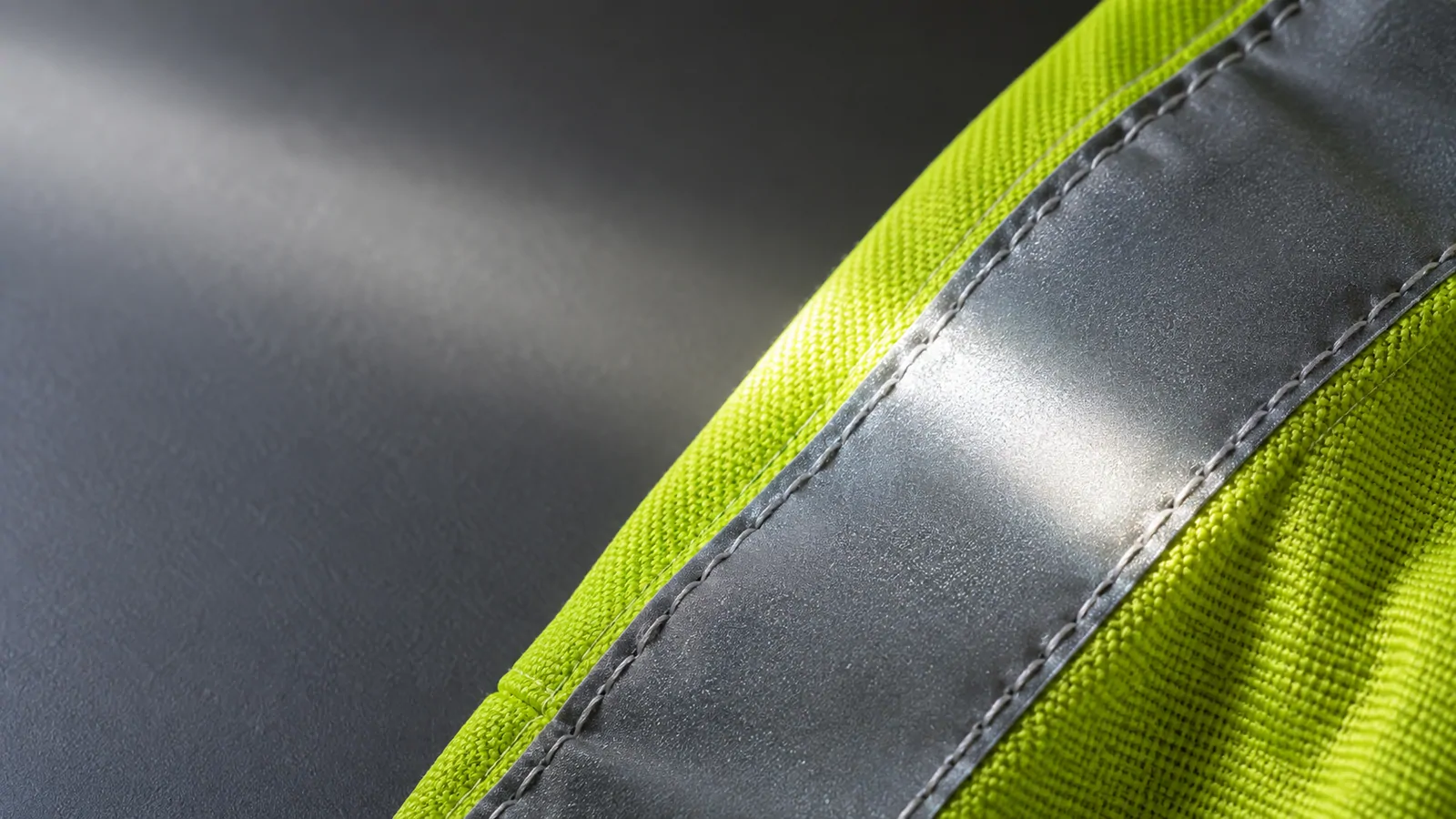
Class 3 carries more visible material than Class 2 under ANSI/ISEA 107-2020: at least 1,240 in² of fluorescent background and 310 in² of retroreflective material, against 775 in² and 201 in². A vest alone cannot be Class 3. Class 3 needs sleeves with retroreflective bands, or a Class 2 top worn with a Class E item. The MUTCD requires Class 2 or 3 in temporary traffic control zones, and the employer’s hazard assessment decides when Class 3 is needed.
What separates Class 2 from Class 3?
ANSI/ISEA 107-2020 rates a garment by how much fluorescent background and retroreflective material it carries, and by where that material sits. Class 2 needs at least 775 in² of background and 201 in² of retroreflective material. Class 3 needs at least 1,240 in² and 310 in². Only the smallest size in a range may use a reduced background area: 540 in² for Class 2 and 1,000 in² for Class 3. Allowed background colors are fluorescent yellow-green, fluorescent orange-red and fluorescent red. The garment label identifies the standard, the garment type and the performance class. Read it before relying on a catalog name.
Class 1, 2, 3 and E at a glance
Minimum areas apply to the finished garment. Class E items have their own minimums but are not compliant on their own.
| Class | Background | Retroreflective | Typical garments |
|---|---|---|---|
| Class 1 | 217 in² | 155 in² | Off-road vests (Type O) |
| Class 2 | 775 in² | 201 in² | Vests, shirts, jackets |
| Class 3 | 1,240 in² | 310 in² | Sleeved shirts, jackets, coveralls |
| Class E | Own minimum | Own minimum | Pants, shorts, gaiters |
Why a vest cannot be Class 3
A sleeveless garment or vest alone cannot be Class 3, however much material it carries. Class 3 needs sleeves with retroreflective bands. A long-sleeve shirt, jacket or coverall can therefore qualify on its own when the finished garment also meets the Class 3 areas. The other route is an ensemble. A Class E item, such as pants, bib overalls, shorts, rain pants or gaiters, worn with a Class 2 top forms a Class 3 ensemble. Bands on the arms and legs outline a moving body, which helps drivers recognize a person. If a crew relies on an ensemble, specify and issue both pieces together.
When does the job call for Class 3?
Section 6C.05 of the Manual on Uniform Traffic Control Devices (MUTCD), 11th Edition, requires Performance Class 2 or 3 apparel for all workers within the right-of-way in a temporary traffic control zone. It adds that flaggers should wear Class 3 at night. OSHA’s flagger rule, 29 CFR 1926.201(a), points to the same part of the MUTCD. Above that floor, the employer’s hazard assessment decides. Faster traffic, darkness, rain or fog, cluttered backgrounds and tasks that pull attention away from traffic often move a crew to Class 3. Agencies and contracts can also set the class. The underlying risk is being struck by vehicles or equipment, a hazard OSHA covers in its struck-by guidance.
Colors and tape for work zones
ANSI/ISEA 107 allows three background colors. The MUTCD names only fluorescent orange-red, fluorescent yellow-green or a combination of the two for temporary traffic control zones. A fluorescent red garment can carry an ANSI class and still fall outside that list. For retroreflective material, the MUTCD lists orange, yellow, white, silver, yellow-green or a fluorescent version of these colors. Ask which performance level the tape documents state. Level 2 material has a coefficient of retroreflection of at least 330 cd/(lx·m²) at a 0.2° observation angle and 5° entrance angle. Approve tape color and layout on a physical sample, not on a screen.
How pockets, logos and sizes change the result
The class belongs to the finished garment. A tape or fabric certificate describes a component, not the complete garment. Contrast pockets, logos, dark panels and wide binding can all reduce the visible background, and a logo placed on fluorescent fabric covers area that would otherwise count. Size grading matters too. The smallest size carries the least material, and only that size may use the reduced background allowance. Review the decorated garment in the smallest size ordered, not only the sample size. A new color, material, tape layout, pocket or logo position means the finished configuration must be reviewed again.
What to confirm before ordering
Use these checks when comparing samples or quotes for Class 2 and Class 3 garments.
- The label names ANSI/ISEA 107-2020, garment type R or P and the class.
- The background color is accepted on site, with an agreed tape color and layout.
- The smallest size in the run still meets the class minimums.
- Logo method, size and position are approved on the decorated sample.
- The pairing is recorded when Class 3 relies on a Class E item.
- Documents name the finished garment, not only its tape or fabric.
Catalog starting points
Catalog starting points include the HV-V212 surveyor vest, sleeved styles such as the HV-S130 vented work shirt and HV-J410 insulated bomber, and the HV-P720 performance work pant for ensembles. Classification, labels and documents are confirmed for the finished configuration of each order, never inferred from a style name. Any change to color, material, tape layout, pockets or logo placement means the finished configuration is reviewed again. Samples and pre-production samples are confirmed case by case through an inquiry.
Common questions
Can a safety vest be ANSI Class 3?
No. Under ANSI/ISEA 107-2020, a sleeveless garment or vest alone cannot be Class 3. Class 3 needs sleeves with retroreflective bands, or it is reached as an ensemble, such as a Class 2 vest worn with Class E pants, bib overalls, shorts or gaiters.
Is Class 2 enough for road work?
Class 2 meets the MUTCD baseline for workers within the right-of-way in a temporary traffic control zone, but the MUTCD says flaggers should wear Class 3 at night. Agency rules, contract specifications and the employer’s hazard assessment can also call for Class 3.
Does a logo affect a garment’s ANSI class?
It can. A logo, pocket or contrast panel placed on fluorescent background reduces the background area that counts toward the class. Confirm the class on the finished, decorated garment in the smallest size ordered, not on the plain style or a fabric certificate.
What does Level 2 retroreflective material mean?
In ANSI/ISEA 107, Level 2 retroreflective material has a coefficient of retroreflection of at least 330 cd/(lx·m²) at a 0.2° observation angle and 5° entrance angle. The tape rating alone does not classify a garment. The finished layout must also meet the class areas.
Sources and further reading
ISEA: ANSI/ISEA 107-2020 high-visibility safety apparelFHWA Manual on Uniform Traffic Control Devices (MUTCD)OSHA 29 CFR 1926.201: signaling and flaggersOSHA struck-by hazardsTurn the guide into a product brief.
Choose a product or send the requirement that still needs a recommendation.
Explore workwear