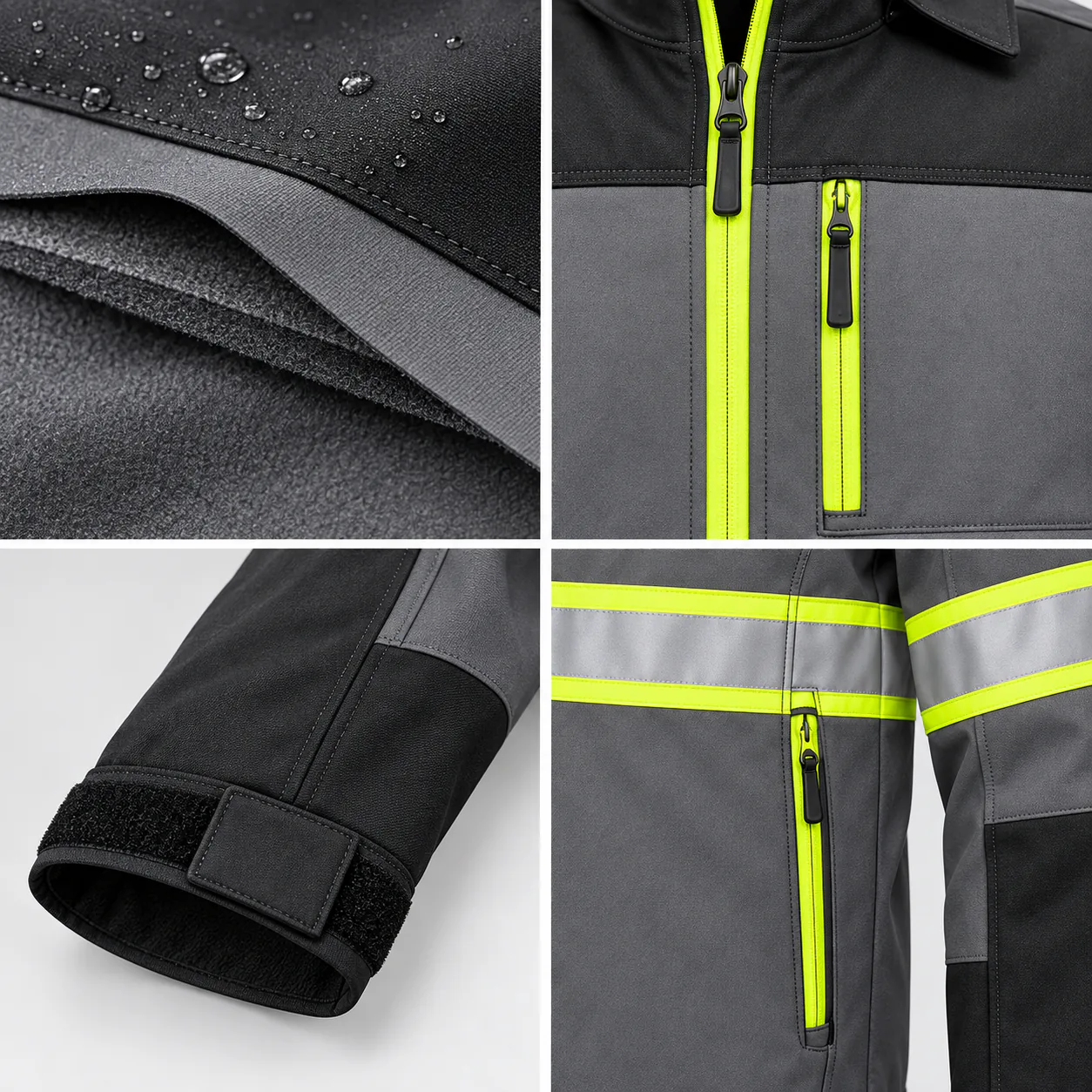
Match the jacket to the conditions crews meet most often: a waterproof shell with sealed seams for rain, an insulated bomber or parka for cold, and a softshell for wind and active work. The outermost layer as worn must carry the required visibility class, so a jacket worn over a vest has to provide it. In Europe, EN 343 rates rainwear, while EN 342 and EN 14058 cover cold and cool conditions.
Start with the conditions
List the weather crews meet routinely and occasionally: temperature range, rain, wind and snow, and how long they stay outside. Add the activity level. A surveyor walking all day overheats in a jacket built for a flagger standing still in the cold. Water resistance, wind resistance, insulation and breathability are separate properties, and one garment rarely leads on all of them. A layering system often works better than one heavy jacket.
Jacket types compared
Each construction solves a different problem. Combine them as layers where conditions change through the day.
| Type | Best for | Watch for |
|---|---|---|
| Waterproof shell | Rain, wet work | Sweat in active work |
| Insulated bomber | Cold, low activity | Overheating, bulk |
| Softshell | Wind, light rain, movement | Sustained rain |
| Fleece mid-layer | Warmth under a shell | Wind and rain |
| Parka | Severe cold | Weight, mobility |
How is rainwear rated in Europe?
EN 343:2019 rates protective clothing against rain on two scales: water penetration resistance in classes 1 to 4 and water-vapor resistance, or breathability, in classes 1 to 4. Class 4 is the highest on both. A jacket with a high waterproof class but a low breathability class keeps rain out but traps sweat during active work. For cold, EN 342 covers protective ensembles below -5 °C, and EN 14058 covers garments for cool environments down to -5 °C.
The outer layer carries the visibility
If a jacket is worn over a hi-vis vest, the vest no longer counts; the jacket must provide the required class on its own. Under ANSI/ISEA 107, a sleeved jacket can reach Class 3 when the finished garment meets the Class 3 areas of at least 1,240 in² of background and 310 in² of retroreflective material. EN ISO 20471 Class 3 garments cover the torso and have sleeves with retroreflective bands or full-length banded trouser legs. Check the class with the jacket fully closed.
Two-tone designs and dark panels
Two-tone jackets combine a fluorescent upper body with a darker lower panel, often navy or black, where dirt and wear collect. They stay presentable for longer, but dark panels do not count as background material. Confirm that the fluorescent area and tape still meet the class in the smallest size ordered. The HV-J525 two-tone performance softshell is one catalog example of this construction; its classification is confirmed for the finished configuration of each order.
Hoods, cuffs and closures
Check these details on the sample with gloves and a hard hat on.
- Hoods that fit over or under a hard hat without blocking side vision.
- Storm flaps over zippers, with pullers large enough for gloves.
- Adjustable cuffs that seal over gloves.
- Hem adjustment that keeps wind out without riding up.
- Pockets that stay sealed in rain.
- Retroreflective bands that stay visible with the hood up.
Flame-resistant cold-weather layers
A hi-vis classification does not make a jacket flame resistant. Where the hazard assessment calls for FR clothing, the jacket is tested to its own standard, such as NFPA 2112 or ASTM F1506 in the United States, or EN ISO 11612 and IEC 61482-2 in other markets. FR garments need FR-compatible reflective tape, thread and trims, and an outer layer worn over FR clothing should also be FR. Catalog FR styles, such as the S252547 rail softshell, are confirmed for the finished configuration of each order.
What to send with a jacket inquiry
These details let the manufacturer recommend a construction and layer system.
- Temperature range and typical weather for the season.
- Activity level and shift length for each role.
- Required standard and class for the outer layer.
- Waterproofing and breathability targets, if any.
- FR requirements from the hazard assessment.
- Layers worn underneath, for sizing.
Common questions
Can a hi-vis jacket replace a safety vest?
Yes, if the jacket itself meets the required class as worn. A jacket worn over a vest hides it, so the jacket must provide the visibility. A sleeved jacket can reach ANSI/ISEA 107 Class 3 when the finished garment meets the Class 3 areas.
What does EN 343 class 4 mean?
EN 343:2019 rates rainwear for water penetration resistance and water-vapor resistance, each in classes 1 to 4. Class 4 is the highest on each scale. Read both numbers: a jacket that keeps rain out but breathes poorly can leave wearers wet from sweat during active work.
Is a softshell jacket waterproof?
Usually not fully. A softshell resists wind and light rain and moves with the wearer, which suits active work in cool, changeable weather. For sustained rain, use a waterproof shell rated for the conditions, and make sure the outer layer carries the required visibility class.
Do FR jackets need special reflective tape?
Yes. Ordinary tape, thread or trims can compromise flame resistance. FR jackets need FR-compatible tape, thread and trims, and the finished jacket is tested to its FR standard, such as NFPA 2112, ASTM F1506 or EN ISO 11612.
Sources and further reading
ISEA: ANSI/ISEA 107-2020 high-visibility safety apparelISO 20471 overviewEU-OSHA OSHwiki: reflective clothingConstruction buyer discussion: vest qualityTurn the guide into a product brief.
Choose a product or send the requirement that still needs a recommendation.
Explore workwear