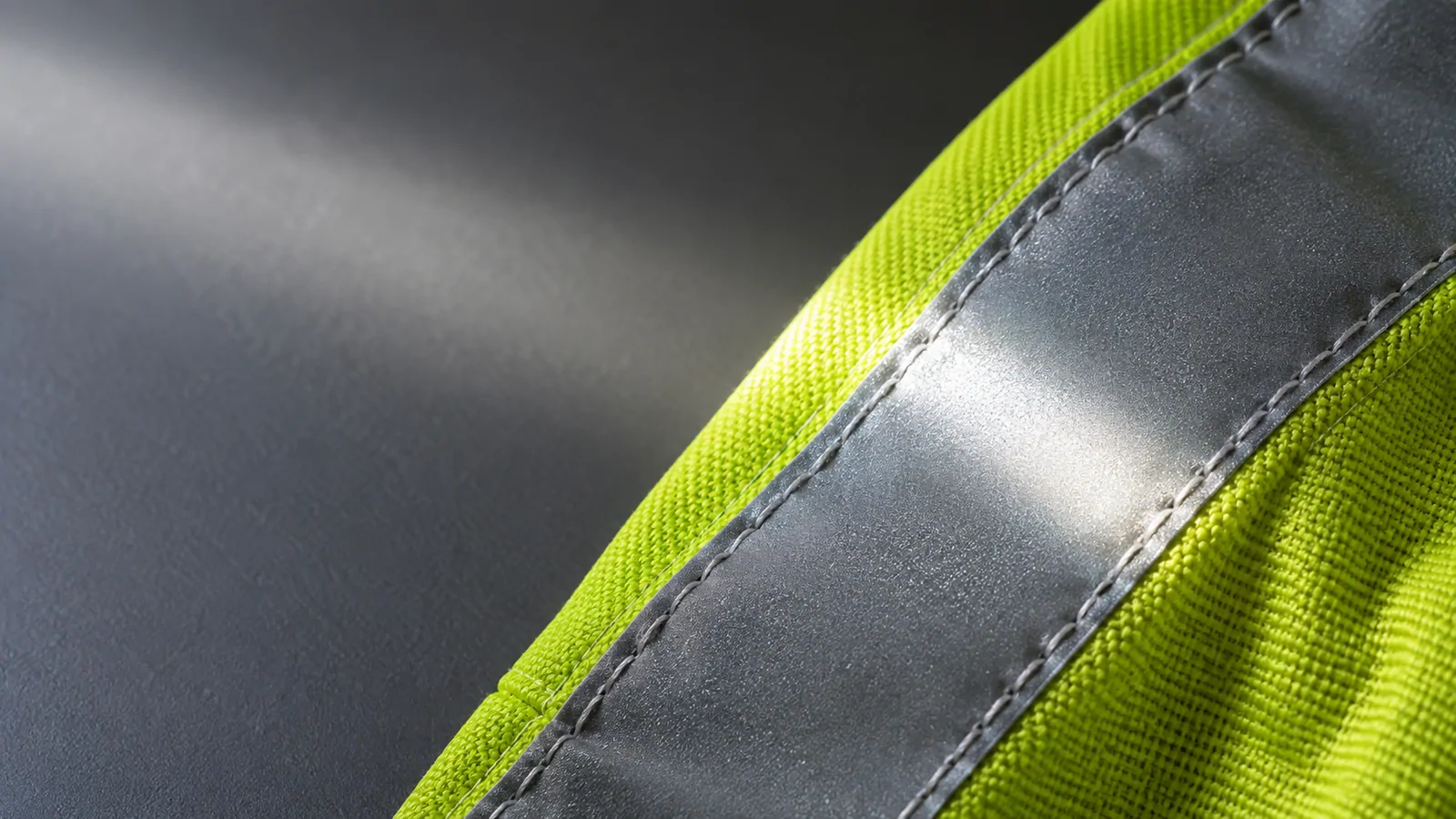
A hi-vis specification mixes standard names, material terms and factory shorthand. This glossary defines them in plain English: the standards and classes buyers cite, such as ANSI/ISEA 107 and EN ISO 20471; fluorescent and retroreflective materials; fabric terms such as GSM and denier; closures such as the 5-point breakaway; flame and weather protection standards; and the words used when a sample is approved for production.
Standards and classes
These names appear on tenders, labels and product sheets. Confirm which one applies in the buyer’s market before choosing a garment.
| Term | What it means |
|---|---|
| ANSI/ISEA 107 | The U.S. standard for high-visibility safety apparel, published by the International Safety Equipment Association; the current edition is ANSI/ISEA 107-2020. It defines garment types, performance classes, minimum material areas and placement. |
| Type O, R and P | ANSI/ISEA 107 garment types: Type O (off-road) for workers away from public roads, Type R (roadway) for road rights-of-way and temporary traffic control zones, and Type P (public safety) for emergency and law-enforcement personnel. |
| ANSI Class 1, 2 and 3 | Performance classes set by minimum areas of fluorescent background and retroreflective material: 217 and 155 in² for Class 1, 775 and 201 in² for Class 2, and 1,240 and 310 in² for Class 3. Class 3 also needs coverage on the arms or legs, so a vest alone cannot be Class 3. |
| Class E | ANSI/ISEA 107 supplemental garments such as pants, bib overalls and shorts. A Class E item worn with a Class 2 top forms a Class 3 ensemble. |
| EN ISO 20471 | The international standard for high-visibility clothing for professional use. Class 1, 2 and 3 garments need at least 0.14 and 0.10 m², 0.50 and 0.13 m², and 0.80 and 0.20 m² of background and retroreflective material. |
| CSA Z96 | The Canadian standard for high-visibility safety apparel, known for the X-back stripe layout. |
| AS/NZS 4602.1 | The Australian and New Zealand standard for high-visibility garments, with Class D (day), Class N (night) and Class D/N (day and night) garments. |
| RIS-3279-TOM | The RSSB standard for high-visibility clothing on Great Britain’s rail network, which specifies orange garments. |
| MUTCD | The U.S. Manual on Uniform Traffic Control Devices. It requires workers exposed to traffic within the highway right-of-way to wear high-visibility apparel that meets ANSI/ISEA 107. |
| PPE Category II | Under Regulation (EU) 2016/425, high-visibility clothing is Category II personal protective equipment and needs an EU type-examination by a notified body before it carries the CE mark. |
Visibility materials
Hi-vis performance comes from two different materials. Daylight visibility depends on fluorescent color; night visibility depends on retroreflection.
| Term | What it means |
|---|---|
| Background material | Fluorescent material that makes the wearer conspicuous in daylight and at dusk. EN ISO 20471 allows fluorescent yellow, orange-red and red; ANSI/ISEA 107 allows fluorescent yellow-green, orange-red and red. |
| Retroreflective material | Material that returns light toward its source, so vehicle headlights make the wearer visible at night. |
| Combined-performance material | Material that is both fluorescent and retroreflective, such as reflective tape with a fluorescent face. |
| Coefficient of retroreflection | How much light a retroreflective material returns, in cd/(lx·m²). New material under EN ISO 20471, and ANSI/ISEA 107 Level 2 material, must reach at least 330 at a 0.2° observation angle and 5° entrance angle. |
| Glass-bead tape | Retroreflective tape made of tiny glass spheres bonded to a fabric or film backing. Flexible, easy to sew and common on vests, shirts and work pants. |
| Microprismatic tape | Retroreflective tape with molded prism structures in a plastic film. Common on rainwear and coated fabrics; stiffer than glass-bead tape. |
| Segmented tape | Reflective tape cut into short segments on a flexible backing, so the garment bends and breathes more easily. |
| Heat-applied tape | Reflective material bonded with heat and pressure instead of stitching. Lighter and flatter; adhesion has to be proven on the actual fabric and laundering route. |
| X-back | Two diagonal reflective stripes that cross on the back, the layout associated with CSA Z96. |
| 360° banding | Reflective bands that run all the way around the torso, arms or legs, so the wearer is visible from every direction. |
Fabric terms
Fabric is specified by composition, weight and construction together. These terms describe each part.
| Term | What it means |
|---|---|
| GSM | Grams per square meter, the usual measure of fabric weight. |
| oz/yd² | Ounces per square yard, the U.S. measure of fabric weight; 1 oz/yd² is about 33.9 GSM. |
| Denier (D) | The thickness of a yarn: the weight in grams of 9,000 meters of it. A 300D oxford uses thicker yarn than a 150D oxford. |
| Mesh | An open knit with holes for airflow, used for lightweight warm-weather vests. |
| Tricot | A closed, smooth knit, usually polyester, that gives a clean surface for printing. |
| Birdseye | A knit with a small textured eyelet pattern, often used for hi-vis polos and shirts. |
| Oxford | A woven fabric with a basket-like weave, often polyester and often coated for jackets and rainwear. |
| PU coating | A polyurethane layer on the back of a fabric that adds wind and water resistance. |
| CVC | Chief value cotton: a cotton-polyester blend with more cotton than polyester. |
| Softshell | A stretch woven face bonded to a membrane or brushed backing, used for wind-resistant mid-season jackets. |
| Modacrylic | An inherently flame-resistant synthetic fiber, usually blended with other fibers for FR knits and wovens. |
| Aramid | Heat- and flame-resistant synthetic fibers used in FR fabrics and blends. |
| Inherent and treated FR | Inherent FR fabrics resist flame because of the fiber itself; treated FR fabrics, such as FR cotton, rely on a chemical finish. |
Construction and closures
These details decide how a garment works on the job and are checked on the sample.
| Term | What it means |
|---|---|
| 5-point breakaway | A vest that separates at five points, usually the shoulders, sides and front, so it can tear away if it catches on moving equipment. |
| D-ring opening | A slot that lets the D-ring of a fall-arrest harness sit outside the garment. |
| Radio loop and mic tab | A loop or tab that holds a radio or microphone near the chest or shoulder. |
| Storm flap | A fabric flap over a zipper that keeps wind and rain out. |
| Two-way zipper | A zipper that opens from the top or the bottom, common on coveralls and long jackets. |
| Bartack | A short, dense stitch that reinforces stress points such as pocket corners. |
| Binding | A fabric strip that finishes a raw edge, common on vest armholes and hems. |
| Two-tone | A garment with a darker lower body or contrasting color blocks; the fluorescent area still has to meet the class. |
Flame and weather protection
Hi-vis garments for hot work, electrical work or bad weather are also specified to these standards. Each needs documents for the exact fabric and finished garment.
| Term | What it means |
|---|---|
| NFPA 2112 | The U.S. standard for flame-resistant clothing that protects industrial personnel against short-duration thermal exposures from fire, such as flash fire. |
| ASTM F1506 | The U.S. performance specification for flame-resistant and electric arc rated clothing worn by workers exposed to flames and electric arcs. |
| Arc rating (ATPV) | The arc thermal performance value in cal/cm²: the incident energy at which heat transfer through the fabric has a 50% probability of causing a second-degree burn. |
| EN ISO 11612 | The European and international standard for clothing that protects against heat and flame. |
| EN ISO 14116 | Covers materials and clothing with limited flame spread; it is not a full heat-protection standard. |
| IEC 61482-2 | The international standard for clothing that protects against the thermal hazards of an electric arc. |
| EN 343 | Protective clothing against rain, classed 1 to 4 for water penetration resistance and water vapor resistance in the 2019 edition. |
| EN 342 and EN 14058 | European standards for clothing against cold: EN 342 for environments below −5 °C and EN 14058 for cool environments down to −5 °C. |
Ordering and approval
These terms appear in quotations and sample reviews.
| Term | What it means |
|---|---|
| MOQ | Minimum order quantity. Safvero’s standard factory MOQ is 100 pieces; fully customized products have an MOQ of 300–500 pieces. |
| Lab dip | A dyed fabric swatch made to match a color target and approved before bulk dyeing. |
| Pantone TCX and TPX | Textile color references (cotton and paper) used to state a target color. |
| Pre-production sample | A sample made with production materials and methods, approved before bulk production starts. |
| Tech pack | The technical file for a garment: sketches, measurements, materials, trims, labels and packing. |
| Private label | Garments made under the buyer’s brand, with the buyer’s labels, hangtags and packaging. |
| Grading | Scaling a pattern from the sample size to every size in the range. |
| ISO 15797 | Industrial washing and finishing procedures used to test workwear; reflective materials may be rated for a stated number of these cycles. |
| ISO 3758 | The international care symbols for washing, bleaching, drying, ironing and professional cleaning. |
Common questions
What is the difference between fluorescent and retroreflective material?
Fluorescent background material makes the wearer stand out in daylight and at dusk. Retroreflective material returns light from headlights at night. Hi-vis classes set minimum areas of both.
What does Type R mean on a hi-vis vest?
Type R is the ANSI/ISEA 107 garment type for workers in road rights-of-way and temporary traffic control zones. Type R garments are Class 2 or Class 3.
What is a 5-point breakaway vest?
A vest that separates at five points, usually both shoulders, both sides and the front, when it is pulled, so it can tear away if it catches on moving equipment. Specify the required release-point layout and confirm its operation on the intended sample.
What does GSM mean on a fabric specification?
Grams per square meter, the fabric’s weight. Read it with the composition and construction: a 100–130 GSM mesh option for an HV-V101 custom order and a 300 gsm FR knit sweatshirt are both specified in GSM but are very different fabrics. Agree the final mesh specification before ordering.
Sources and further reading
ISEA: ANSI/ISEA 107-2020 high-visibility safety apparelISO 20471 overviewCCOHS: high-visibility safety apparel (CSA Z96)RSSB: RIS-3279-TOM high visibility clothingRegulation (EU) 2016/425 on personal protective equipmentFHWA Manual on Uniform Traffic Control Devices (MUTCD)NFPA 2112: flame-resistant clothing for protection against short-duration thermal exposures from fireASTM F1506: flame-resistant and electric arc rated protective clothingISO 15797: industrial washing procedures for testing workwearTurn the guide into a product brief.
Choose a product or send the requirement that still needs a recommendation.
Explore workwear