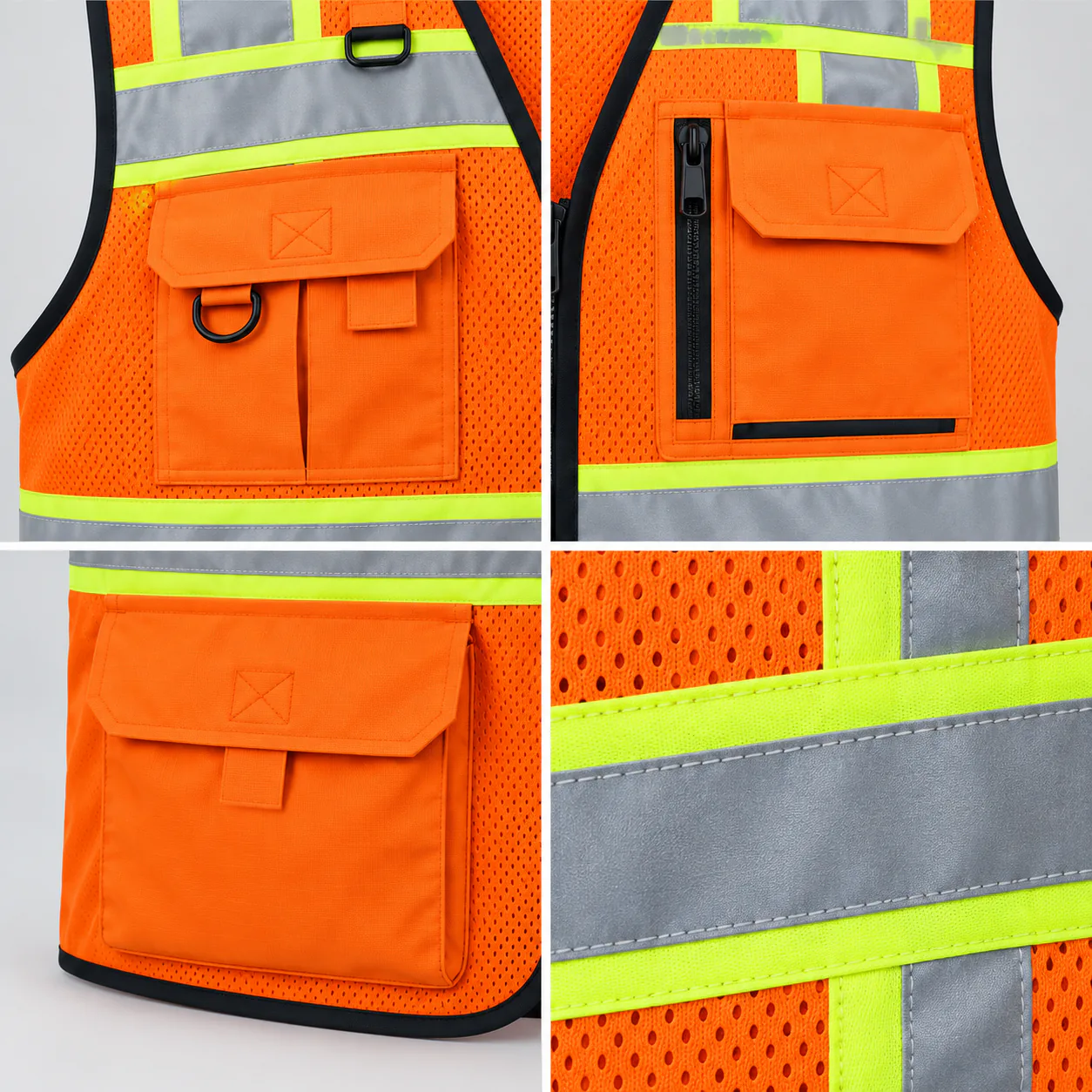
Start from what each wearer carries, not from a pocket count. General crews often need only an ID holder and one or two small pockets. Surveyors and supervisors usually need radio, phone, pen, notebook and tablet storage; surveyor-style vests such as the HV-V212 carry ten pockets. Every pocket should have a defined use, hold its load steady and leave the required retroreflective bands and background visible.
Map pockets to the role
Different roles carry different kit. Use the role, not the catalog feature line, to plan storage.
| Role | Typical items | Pocket plan |
|---|---|---|
| General crew | ID, phone | ID holder, one chest pocket |
| Flagger | Radio, phone | Radio pocket, mic tab |
| Surveyor | Tablet, field book, pens | Large lower pockets, pen slots |
| Supervisor | Radio, phone, documents | Chest radio, document pocket |
| Inspector | Camera, forms, tape | Zip pocket, inside pocket, D-ring |
List what each wearer carries
Record the actual items with their size and weight: radio model, phone, ID badge, pens, field book, tablet, tape measure, keys and hand tools. Include items carried only on some days. A tablet pocket sized for the bare device may not fit a rugged case, and a radio pocket sized without the antenna fails in use. Asking a few wearers to empty their pockets at the end of a shift gives a more reliable list than a feature description.
Where should each pocket sit?
Put frequently used items where the wearer can reach them without looking: the radio on the chest with a mic tab near the collar, ID at chest height and pens in a slot that keeps them upright. Large or heavy items belong low on the front or in an inside pocket, so the vest does not pull forward. Keys and tape measures can hang from a D-ring. Every unused pocket adds weight, cost and another snag point.
Keep pockets and tape compatible
Pockets and flaps must not cover or interrupt required retroreflective bands. Pockets made of non-fluorescent material, such as dark mesh or black binding, reduce the visible background area, and a heavy pocket can pull tape out of line. Under ANSI/ISEA 107, Class 2 needs at least 775 in² of background and 201 in² of retroreflective material on the finished garment. Review the tape route and the smallest size after every pocket change.
Closures and reinforcement
Check these points on the sample with every pocket loaded.
- Flaps that stay shut when the wearer bends.
- Zippers that run smoothly with gloves on.
- Bartacks at pocket corners and D-ring anchors.
- Radio and phone pockets that hold their load upright.
- Inside pockets that open without removing the vest.
- Hook-and-loop that still grips after washing.
Test access in motion
Load every pocket and wear the vest over the real work layers, including any harness, tool belt or jacket. Reach for each item while standing, kneeling and climbing into equipment. A pocket that sits under a harness strap or behind a tool belt is effectively unusable. Check that heavy pockets do not swing when the wearer walks or bends, and that the vest still closes over the outer layer.
Common pocket mistakes
Most pocket problems show up only after the first weeks of wear. Check the sample for these before approval.
- Pockets sized for the bare device instead of the device in its case.
- Heavy items placed high on the chest, pulling the vest forward.
- Flaps that cover retroreflective tape when open.
- More pockets than the role uses.
- Closures that need two hands or bare fingers.
Pocket changes and the finished configuration
Moving, adding or enlarging a pocket changes the finished garment. At Safvero, pocket architecture is one of the customization routes, and any change to pockets means the finished configuration, including its classification, is reviewed again. Record each pocket's size, position, closure and intended contents in the specification, so repeat orders keep the same layout and the approved sample stays the reference.
Pocket specification checklist
Write these details into the specification before sampling.
- Item each pocket is designed to hold, with its size.
- Position, measured from fixed points such as the shoulder seam.
- Closure type: flap, zipper, hook-and-loop or open.
- Reinforcement at corners and attachment points.
- Clearance from retroreflective bands in every size.
Common questions
How many pockets should a surveyor vest have?
Enough for what the surveyor carries, typically a radio, phone, pens, field book, tablet and tape measure. Surveyor-style vests such as the HV-V212 carry ten pockets. Count the items and their sizes first, then remove any pocket without a defined use.
Do pockets affect a safety vest's ANSI class?
They can. Pockets and flaps must not cover required retroreflective bands, and pockets made of non-fluorescent material reduce the counted background area. Confirm the class on the finished garment, with its pocket layout, in the smallest size ordered.
What is a mic tab on a safety vest?
A mic tab is a small loop or tab near the collar or shoulder that holds a radio's speaker microphone close to the wearer's ear and mouth, while the radio stays in a chest pocket. Check its position with the radio model the crew actually uses.
Should a safety vest have a tablet pocket?
Only if the role uses a tablet in the field. Size the pocket for the tablet in its protective case, place it low on the front or inside, and check that it does not pull the vest forward or cover tape when loaded.
Sources and further reading
ISEA: ANSI/ISEA 107-2020 high-visibility safety apparelConstruction buyer discussion: vest qualityTurn the guide into a product brief.
Choose a product or send the requirement that still needs a recommendation.
Explore workwear