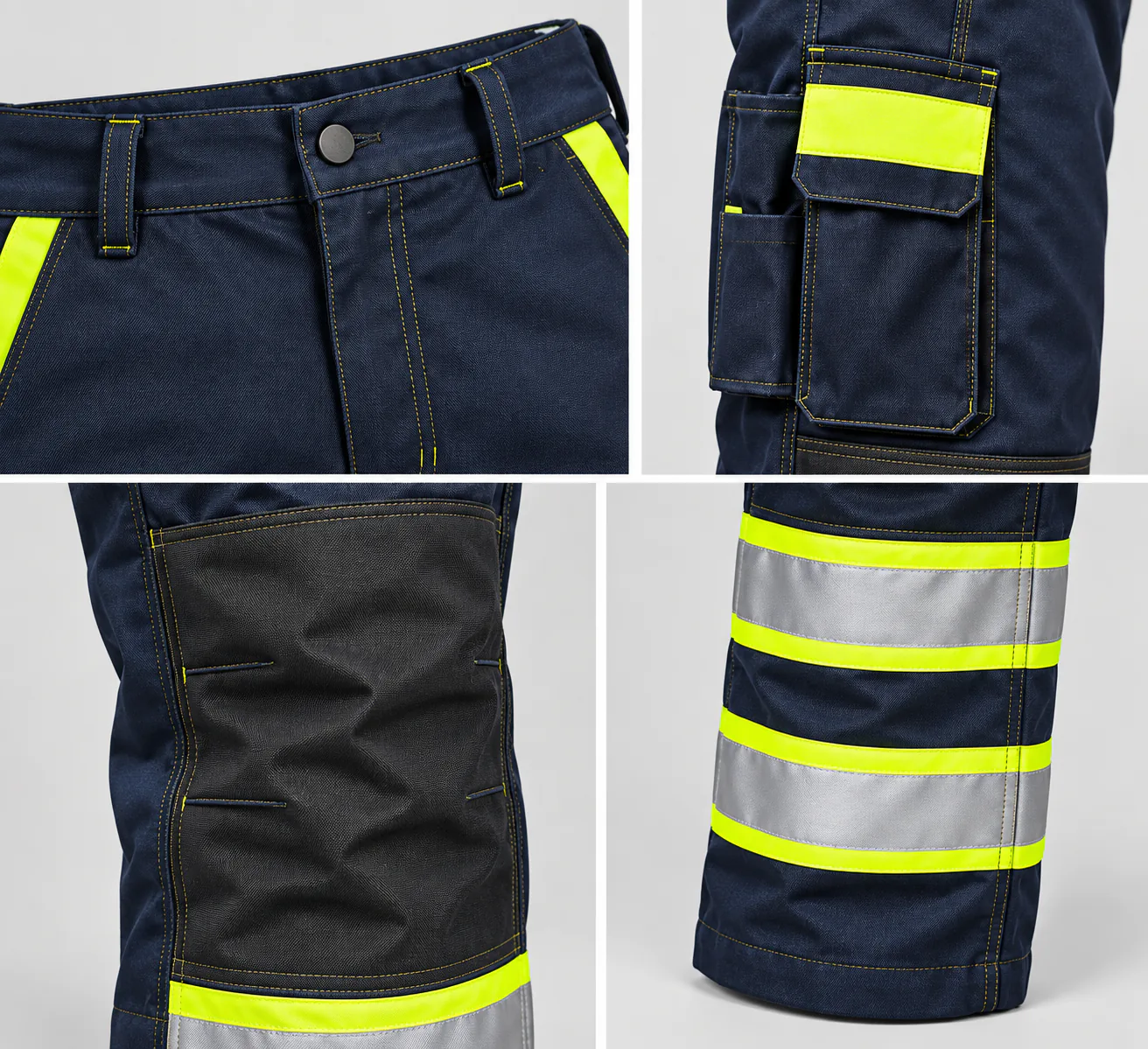
Class E is the ANSI/ISEA 107-2020 category for supplemental items: pants, bib overalls, shorts, rain pants and gaiters. They meet minimum material requirements but are not compliant on their own. Worn with a Class 2 vest, shirt or jacket, a Class E item forms a Class 3 ensemble. Specify, sample and issue the top and bottom together, because the Class 3 rating depends on both pieces.
What does Class E mean?
Class E items carry fluorescent background and retroreflective material, usually as bands around the legs. They meet the minimum material requirements set for supplemental items, but a Class E item worn alone, or with an unrated top, gives the wearer no performance class. Its value is in the ensemble. Leg bands outline the lower body in headlights, so drivers see the full shape of a moving person rather than a torso alone. A common reason to add Class E items is a job that calls for Class 3 when the crew’s top is a Class 2 vest.
Which combinations reach Class 3?
Under ANSI/ISEA 107-2020, the rating depends on the pieces worn together. Check each label and record the pairing.
| Top | Bottom | Result |
|---|---|---|
| Class 2 vest | Class E pant | Class 3 ensemble |
| Class 2 shirt or jacket | Class E shorts or bib overall | Class 3 ensemble |
| Class 3 jacket or shirt | Class E pant | Class 3, legs outlined |
| Class 2 vest | Unrated work pant | Class 2 only |
| None or unrated | Class E pant | No class on its own |
Specify the ensemble, not just the pant
Because the Class 3 result depends on two garments, both belong in the purchase specification. Name the top and the pant by style, class and color. On U.S. road jobs, the MUTCD requires Class 2 or 3 apparel for workers within the right-of-way in temporary traffic control zones, with fluorescent orange-red, fluorescent yellow-green or a combination as the background. Check the pant against the same color rule as the top. Issue the pieces as a set, and have supervisors confirm that each wearer has both. An ensemble with one piece missing is Class 2 at best.
Fit decides whether the bands stay visible
Under 29 CFR 1926.95(c), effective January 13, 2025, construction employers must ensure personal protective equipment is of safe design and construction for the work and selected to properly fit each affected employee. For pants, fit is also a visibility question. A hem that pools over boots, a rolled cuff or a leg tucked into boots can hide the bands. Plan waist, inseam and rise options across the crew, including women’s sizes, and size over the base layers worn in cold weather. Check band position while standing, kneeling and climbing.
Construction points to check on a Class E pant
Review these on the physical sample in working postures, not on a flat table.
- Leg band height when standing, kneeling and climbing.
- Hem length options that keep bands above boot tops.
- Cargo and tool pockets that leave required background uncovered.
- Knee shaping and stretch zones for crouching and ladder work.
- Dark reinforcement panels approved on the finished garment.
- Waist adjustment and closures that work over base layers.
Rain, cold and flame-resistant routes
Class E also covers rain pants, but a visibility class does not cover weather protection or flame resistance. In Europe, rainwear is classified under EN 343:2019 for water penetration resistance and water vapor resistance, each in classes 1 to 4, with class 4 the highest in both. EN 14058 covers garments for cool environments down to -5 °C, and EN 342 covers ensembles against cold below -5 °C. Flame-resistant (FR) pants are tested to their own standards, such as NFPA 2112 and ASTM F1506 in the United States or EN ISO 11612 for heat and flame. They need FR-compatible reflective tape, thread and trims.
How do Europe and Canada treat lower-body garments?
EN ISO 20471 has no Class E. Its Class 3 garments cover the torso and have sleeves with retroreflective bands or full-length trouser legs with bands, and garments such as a jacket and trousers can be combined to reach a higher class. In Canada, CSA Z96 Class 2 and Class 3 garments need an X of retroreflective stripes on the back, two front stripes running over the shoulders and a band around the waist. Class 3 adds bands around both arms and both legs. A pant built for a U.S. Class E program may need a new band layout and new documents for these markets.
Sampling and ordering a coordinated set
Relevant catalog styles include the HV-P720 performance work pant, which can be specified alongside the HV-V212 surveyor vest, and the K252525 FR cargo work trouser for flame-resistant programs. Classification, labels and documents are confirmed for the finished configuration of each order. Approve the top and pant together on a physical sample. A digital color preview is a direction only, and any change of color, material, tape layout, pockets or logo placement means the set is reviewed again.
Common questions
Are Class E pants compliant on their own?
No. Under ANSI/ISEA 107-2020, Class E items such as pants, bib overalls, shorts, rain pants and gaiters meet minimum material requirements but are not compliant on their own. They count toward a class only when worn with a qualifying top, such as a Class 2 vest, shirt or jacket.
Does a Class 2 vest with Class E pants make Class 3?
Yes. Under ANSI/ISEA 107-2020, a Class E item worn with a Class 2 top forms a Class 3 ensemble. Check both labels, name both pieces in the purchase specification and issue them as a set. If one piece is missing, the wearer drops to Class 2 or to no class.
Can hi-vis work pants be flame resistant?
Yes, when the pant is built and tested as a flame-resistant (FR) garment. A hi-vis classification does not make a garment flame resistant. FR pants are tested to their own standards, such as NFPA 2112 or ASTM F1506 in the United States, and need FR-compatible reflective tape, thread and trims.
Is there a Class E in EN ISO 20471?
No. EN ISO 20471 uses Classes 1, 2 and 3. Class 3 garments cover the torso and have sleeves with bands or full-length trouser legs with bands, and a jacket and trousers can be combined to reach a higher class. Review a U.S. Class E design again before selling it in Europe.
Sources and further reading
ISEA: ANSI/ISEA 107-2020 high-visibility safety apparelFHWA Manual on Uniform Traffic Control Devices (MUTCD)OSHA 29 CFR 1926.95: criteria for personal protective equipmentEU-OSHA OSHwiki: reflective clothingISO 20471 overviewCCOHS: high-visibility safety apparel (CSA Z96)Turn the guide into a product brief.
Choose a product or send the requirement that still needs a recommendation.
Explore workwear