Do not assume that a standard hi-vis vest is suitable over FR clothing. For work involving flame or electric-arc hazards, the outer vest must be assessed as part of the complete clothing system. High-visibility performance alone does not establish flame resistance or an arc rating. The employer’s qualified safety personnel should determine the required protection and verify the proposed garment combination before use.
High visibility, FR and arc-rated protection: what is the difference?
These descriptions answer different questions. A conspicuity label is not evidence of resistance to heat or flame, and an FR description alone does not establish the arc rating needed for a particular task.
ISO 20471 addresses high-visibility clothing; ISO 11612 addresses clothing for heat and flame; IEC 61482-2 addresses electric-arc thermal hazards. Their public scopes are useful starting points, not substitutes for the required product documents or the applicable market rules.
ISO 20471 — High-visibility clothing: public scopeISO 11612 — Clothing to protect against heat and flame: public scopeIEC 61482-2 — Electric-arc thermal protection: public scope
| Performance claim | What it addresses | What it does not establish |
|---|---|---|
| High visibility | Conspicuity through background material and reflective material in a specified garment configuration. | Flame resistance, an arc rating or electrical insulation. |
| Flame resistance (FR) | Resistance to ignition and flame behaviour under specified conditions, supported by the applicable evidence. | Fireproof clothing or automatic suitability for an electric-arc exposure. |
| Arc-rated protection (AR) | Thermal effects of an electric arc under the relevant assessment and test conditions. | Protection against electric shock or every other effect of an arc. |
Why the outer vest matters
The vest is exposed even when protective clothing is worn underneath. Its fabric, reflective tape, thread, binding, fasteners, labels and decoration belong in the review. A fluorescent colour or a reflective flash cannot show how those components behave during a flame or arc exposure.
For work within the scope of OSHA 1910.269, the employer must assess flame and arc hazards. Its clothing provisions address materials that could melt onto skin or ignite and continue burning; outer-layer flame resistance and arc-rated protection depend on the conditions specified in the rule. This is a task- and exposure-based requirement, not a blanket instruction for every workplace.
OSHA 1910.269 — Electric power generation, transmission and distributionOSHA 1910.269 Appendix E — Protection from flames and electric arcs
Do not treat an ordinary polyester vest as suitable just because the layer beneath it is FR. Equally, do not remove a required visibility garment without an approved alternative. Ask the responsible safety personnel to resolve both requirements for the complete combination.
A tape report answers questions about that material in its assessed form. It does not automatically cover the vest, the attachment process, a new logo or the layers underneath. Review reflective material and layout questions.
Match the requirement to the workplace
Start with the work and destination market, not a garment name or an industry label. Two crews in the same industry may face different exposures. Record the required performance and who is responsible for accepting the proposed clothing system.
OSHA 1910.269 covers specified electric-power work; it should not be presented as the rule for every job. IEC 61482-2 does not cover electric shock or work intentionally using an arc, such as arc welding. ISO 11611 addresses welding and allied processes. Keep these scopes separate when drafting the purchase specification.
OSHA 1910.269 — Electric power generation, transmission and distributionIEC 61482-2 — Electric-arc thermal protection: public scopeISO 11611 — Welding and allied processes: public scope
An ISO document and its adoption into a market’s standards are not interchangeable labels. Confirm the required version, local rules and conformity route with the party responsible for that market; do not infer an EN claim from an ISO number alone. Understand the employer’s role in visibility requirements.
| Requirement to investigate | Buyer’s question | Evidence to request |
|---|---|---|
| Traffic and vehicle visibility | Which visibility requirement applies to this task and finished configuration? | The specified garment type or class, label information and matching product evidence where required. |
| Flame or heat exposure | What exposures and protective-clothing requirements has the employer identified? | Documents and instructions for the exact garment and the required heat/flame performance. |
| Electric-arc thermal exposure | What protection is required for the assessed task and complete clothing system? | Applicable arc-protection evidence and instructions matched to the proposed configuration. |
| Welding and allied processes | Which welding-related requirements apply, alongside any visibility needs? | The relevant welding-clothing evidence; do not substitute an arc-thermal document without checking its scope. |
Check the exact garment, not just the fabric
Ask how the documents correspond to the style, size range, colour, fabric, reflective material, attachment method and trim being supplied. Compare the report or conformity information with the garment label and proposed specification. A document for a different material or configuration does not fill that gap.
Check the issuer, scope, test conditions, product identification and version. Establish whether the evidence relates to a material, a finished garment or a clothing system. Keep a fabric report as fabric evidence rather than expanding it into a claim for every garment made with a similar-looking fabric.
In a Safvero mesh-vest material review, the customer requested 120 GSM polyester mesh. Two suppliers offered the same nominal fabric weight. The review points included mesh structure, hand feel, colour references, applicable material information and the fabric’s assembly with reflective tape. The material and sample were reviewed against that customer’s brief; confirm the fabric for your own order with our team.
These Safvero workwear procurement cases show how material, fit and version checks support sample approval. For an FR or arc-protection order, review the required performance, exact configuration and applicable documents separately.
Material, construction and fit
Review the finished sample over the actual working layers. Check closure, shoulder movement, sleeve behaviour, body coverage and access to pockets or equipment. A size-chart agreement is useful, but it does not replace a wearing trial of the proposed combination.
In a Safvero insulated-jacket sample review, the customer had confirmed the size chart, but wearing the sample over warm layers revealed insufficient shoulder movement. The review checklist covered overhead reach, forward bending and operating the zipper with gloves. Sizing allowance, armhole or sleeve adjustments and zipper-pull changes were directions to assess, not a record that every proposed change had been completed.
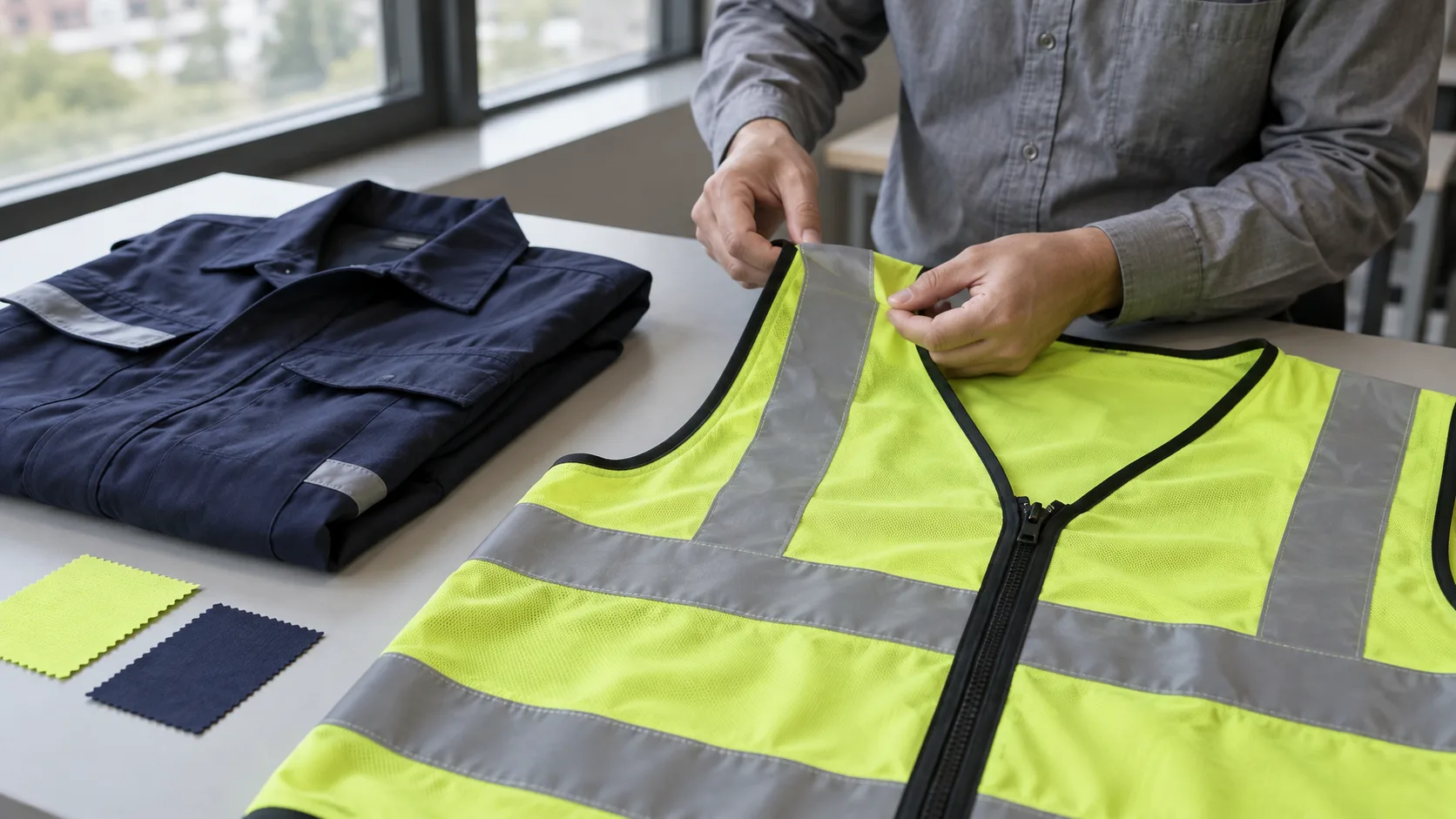
Review fit and protective evidence as separate decisions. A comfortable sample does not prove flame or arc performance. For a multi-hazard brief, verify the complete accepted configuration and manufacturer instructions as well as movement and coverage. Check vest sizing over working layers.
Before approving a sample or bulk order
Use one agreed specification and record which questions remain open. These checks organise the purchase; they are not a substitute for the employer’s protective-clothing decision.
In a Safvero custom-workwear brief, the customer changed a chest logo request from embroidery to heat transfer and asked to move its position. The review points included process feasibility, fabric compatibility, artwork size, nearby construction, reflective layout and the specification version. A branding change is therefore more than replacing the artwork file.
For a garment with required flame or arc protection, assess the proposed decoration and trim against the relevant evidence and instructions. The ordinary-workwear example above does not show that either logo process is acceptable on a protective garment. Obtain the appropriate approval before changing its configuration.
OSHA 1910.269 Appendix E — Protection from flames and electric arcs
Keep the accepted specification, sample reference and changes together. A repeat order should not silently substitute material or decoration while relying on earlier evidence. Record a clear sample approval.
- Intended use and destination market: describe the task, working conditions and applicable requirements.
- Required protective performance: distinguish visibility, heat/flame and electric-arc requirements rather than using one label for all three.
- Exact style and material configuration: identify the garment, fabric, reflective material, closures, binding, thread and other trim.
- Matching documents: verify the scope and product identification of the evidence being relied upon.
- Size and layering: trial the sample with the real underlayers and equipment, including movement and coverage.
- Branding and trim changes: record the method, size and position; confirm the effect on the finished configuration.
- Care instructions: use the instructions for the exact garment and combination; do not assign a universal wash temperature or service life.
- Sample approval and change control: identify the approved version, unresolved points and changes that require renewed review before production.
Common questions
Can a normal hi-vis vest be worn over FR clothing?
Do not assume it can. Where flame or electric-arc hazards exist, have qualified safety personnel assess the outer vest and the full clothing system against the task requirements and matching evidence. An FR layer underneath does not establish the suitability of an ordinary vest.
Is flame-resistant clothing automatically arc-rated?
No. An FR description alone does not establish an arc rating or suitability for a particular electrical task. Ask for evidence matched to the garment and required arc-thermal protection, while keeping shock protection and other PPE requirements separate.
Does a reflective-tape report prove that the vest is protective?
Not by itself. Verify what material, application and test conditions the report covers, then establish which finished-garment or system evidence is needed. The same-looking tape on a different fabric or attached differently is not automatically covered.
Can I add a logo to a vest used over protective clothing?
A proposed logo needs review before approval. Confirm its method, material, size and location, the effect on visible areas, and any implications for the required protective configuration. A decoration accepted on ordinary workwear is not evidence for an FR or arc-rated garment.
How should a layered garment system be washed and checked?
Follow the care instructions for the exact garments and components. Ask how the combination is maintained and inspected, including fabric, tape, closures and decoration. Do not apply a universal wash temperature, wash count or replacement interval to every vest.
What should I request before approving a multi-hazard workwear order?
Request the exact specification, model-specific evidence and instructions, label information, fit and layering requirements, and an approval record for the supplied version. Clarify the scope of every material or garment document and resolve required protective-performance questions before ordering.
This guide supports procurement planning. It does not replace a workplace hazard assessment or task-specific PPE selection by qualified safety personnel.
Sources and further reading
ISO 20471 — High-visibility clothing: public scopeISO 11612 — Clothing to protect against heat and flame: public scopeIEC 61482-2 — Electric-arc thermal protection: public scopeOSHA 1910.269 — Electric power generation, transmission and distributionOSHA 1910.269 Appendix E — Protection from flames and electric arcsISO 11611 — Welding and allied processes: public scopeDiscuss your workwear specification
Share your intended use, destination market, quantity and required documentation with Safvero. Any FR or arc-protection requirement needs a separate capability and evidence review; this article is not a claim that a catalog style meets those requirements.
Discuss requirements