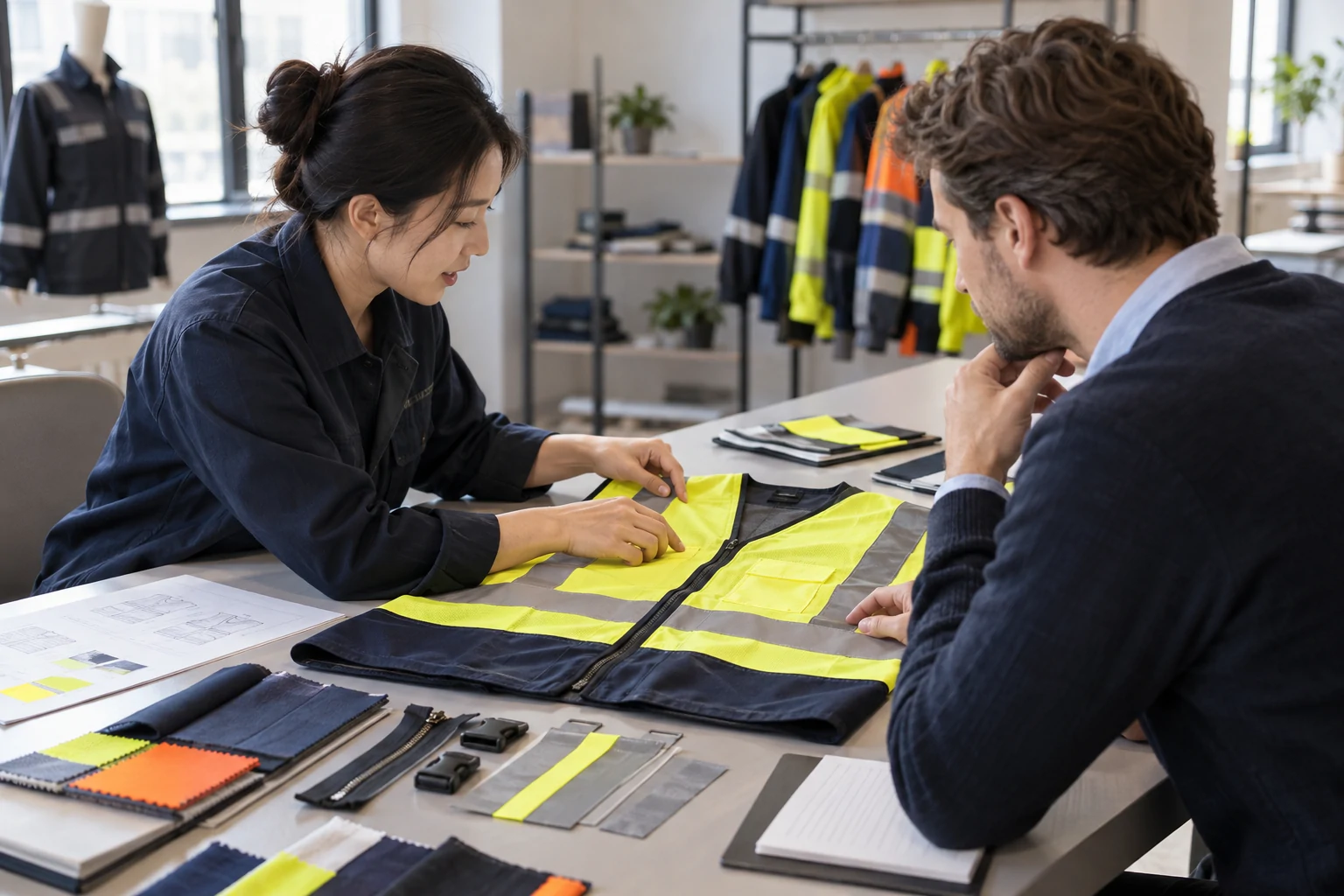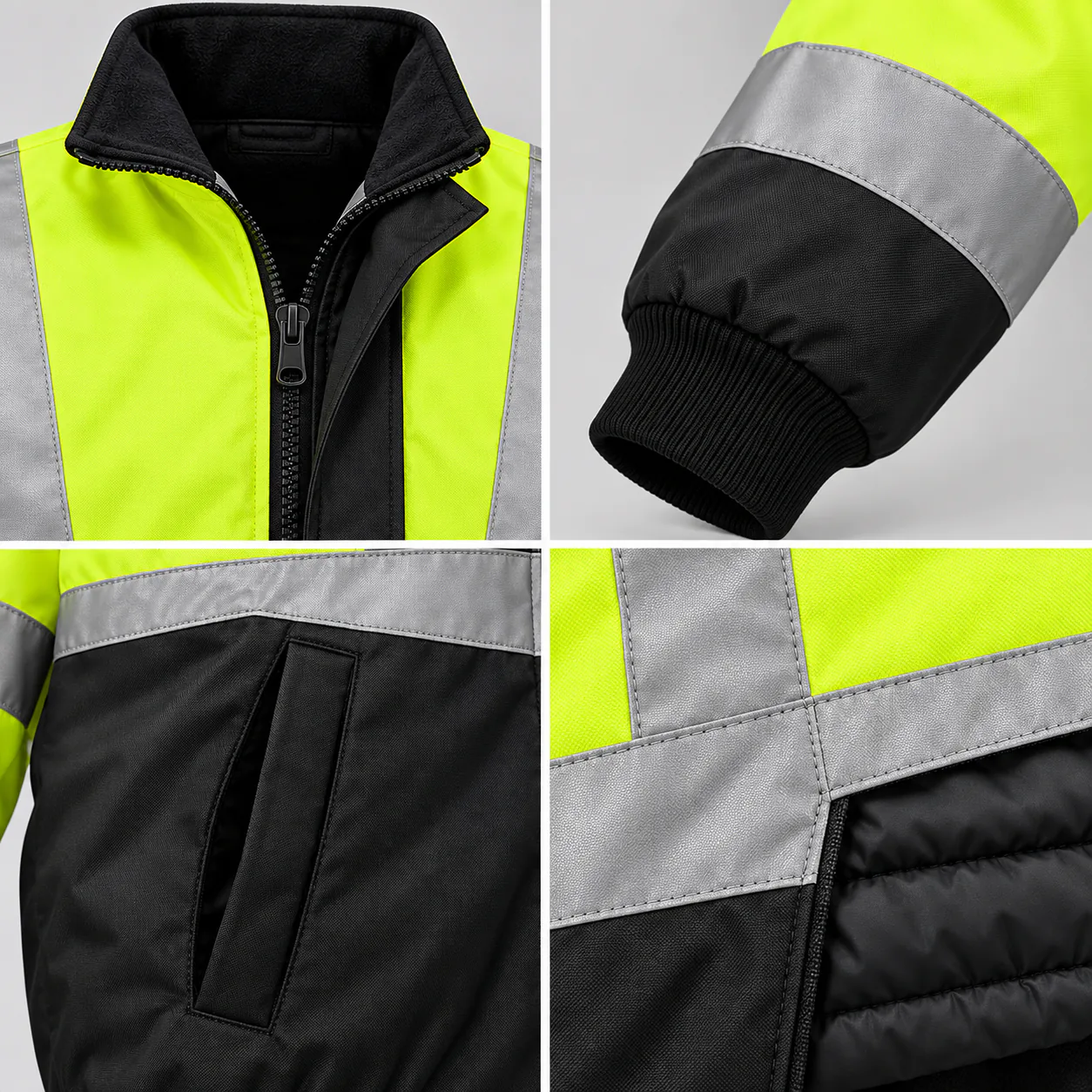
Size high-visibility garments for the clothing they are worn over. Measure wearers in their bulkiest working layers, compare those measurements with finished garment measurements rather than size labels, and check movement in working postures. Confirm that the smallest size ordered still meets the required class and that tape and pockets stay in position on the largest. In US construction, PPE must be selected to properly fit each affected employee.
Fit the whole clothing system
A vest or jacket is the outer layer of a system that changes with the season: a T-shirt in summer, a fleece or insulated mid-layer in winter and rain gear on wet days. List each combination the crew wears and size the outer garment for the bulkiest one it must cover. A vest that fits over a T-shirt may not close over a jacket, and one sized for winter may hang open in summer. Adjustable side straps or separate seasonal sizes solve both problems.
Use garment measurements, not size labels
Size labels vary between suppliers. Finished garment measurements do not, so ask for them in every size.
| Measurement | Why it matters | How to check |
|---|---|---|
| Chest width | Closes over layers | Flat, armpit to armpit |
| Body length | Covers the waist | Shoulder to hem |
| Armhole depth | Reach and comfort | From shoulder seam |
| Sleeve length | Cuff position | Shoulder to cuff |
| Side adjustment | Seasonal fit | Strap range |
Read size designations
Under EN ISO 13688, protective clothing carries a size designation based on body measurements such as height and chest girth, shown in a pictogram. That helps match a size to a wearer, but it does not account for the layers underneath. Ask for a size chart that shows both body measurements and finished garment measurements, then compare the garment's chest width with each wearer's chest measured over working layers.
Check working movement
Try the sample on real wearers in their usual layers, then move through the tasks of a normal shift.
- Reach overhead and across the body.
- Kneel, crouch and bend to the ground.
- Climb into vehicles and onto equipment.
- Sit for a while, then stand up.
- Use the tools and radios the role carries.
- Watch that the hem, closures and tape stay in place throughout.
Check the smallest and largest sizes
Visible material shrinks with size, so the smallest size carries the least background and tape. Under ANSI/ISEA 107, only the smallest size in a range may use a reduced background area: 540 in² for Class 2 or 1,000 in² for Class 3. Confirm that every size ordered meets its class. On the largest sizes, check that bands stay level, pockets stay within reach and the hem does not drape below tool belts. Grade tape and pockets with the body rather than keeping fixed positions.
Fit is a PPE requirement
Under OSHA 29 CFR 1926.95(c), effective January 13, 2025, construction employers must ensure PPE is of safe design and construction for the work and selected to properly fit each affected employee. An oversized vest can snag on equipment or hang open and hide its bands; an undersized one rides up and gaps at the front. In general industry, 29 CFR 1910.132 requires employers to assess hazards and select suitable PPE. Plan the size range so every wearer has a garment that fits.
Plan the size range for an order
Collect sizes from the actual crew rather than a standard ratio, and add a margin for new starters and replacements. Record the layers each size was checked over, and list any women-specific sizes separately. Share the size breakdown for each style and color in the inquiry. Safvero confirms samples case by case through an inquiry, so a set of sizes can be checked on wearers before bulk production.
Sizing brief checklist
Include these points with the inquiry to avoid resizing after the first delivery.
- Seasonal layer combinations worn under the garment.
- Body measurements for the smallest and largest wearers.
- Finished garment measurements requested for each size.
- Required standard and class for the outer layer.
- Size breakdown per style and color, including women's sizes.
Common questions
Should a hi-vis vest be one size bigger?
Often, if it is worn over a jacket or insulated layer. Measure the wearer in the bulkiest layers the vest must cover and compare with the vest's finished chest width. Adjustable side straps help one vest fit over both summer and winter layers.
How do I measure for a safety vest?
Measure the wearer's chest over the layers worn under the vest, then compare it with the garment's finished chest, usually measured flat from armpit to armpit and doubled. Check body length from shoulder to hem, so the vest covers the waist without hanging below a tool belt.
Does vest size affect the ANSI class?
Yes. Smaller sizes carry less material. Under ANSI/ISEA 107, only the smallest size in a range may use a reduced background area, 540 in² for Class 2 or 1,000 in² for Class 3. Every size ordered must still meet its class, so check the smallest size first.
Does OSHA require PPE to fit?
Yes, in construction. Under 29 CFR 1926.95(c), effective January 13, 2025, employers must select PPE that properly fits each affected employee. Plan a size range that covers the whole crew, including smaller and women's sizes, worn over the layers used on the job.
Sources and further reading
OSHA 29 CFR 1926.95: criteria for personal protective equipmentOSHA 29 CFR 1910.132: general requirements for PPEISEA: ANSI/ISEA 107-2020 high-visibility safety apparelISEA: PPE fit for allTurn the guide into a product brief.
Choose a product or send the requirement that still needs a recommendation.
Explore workwear