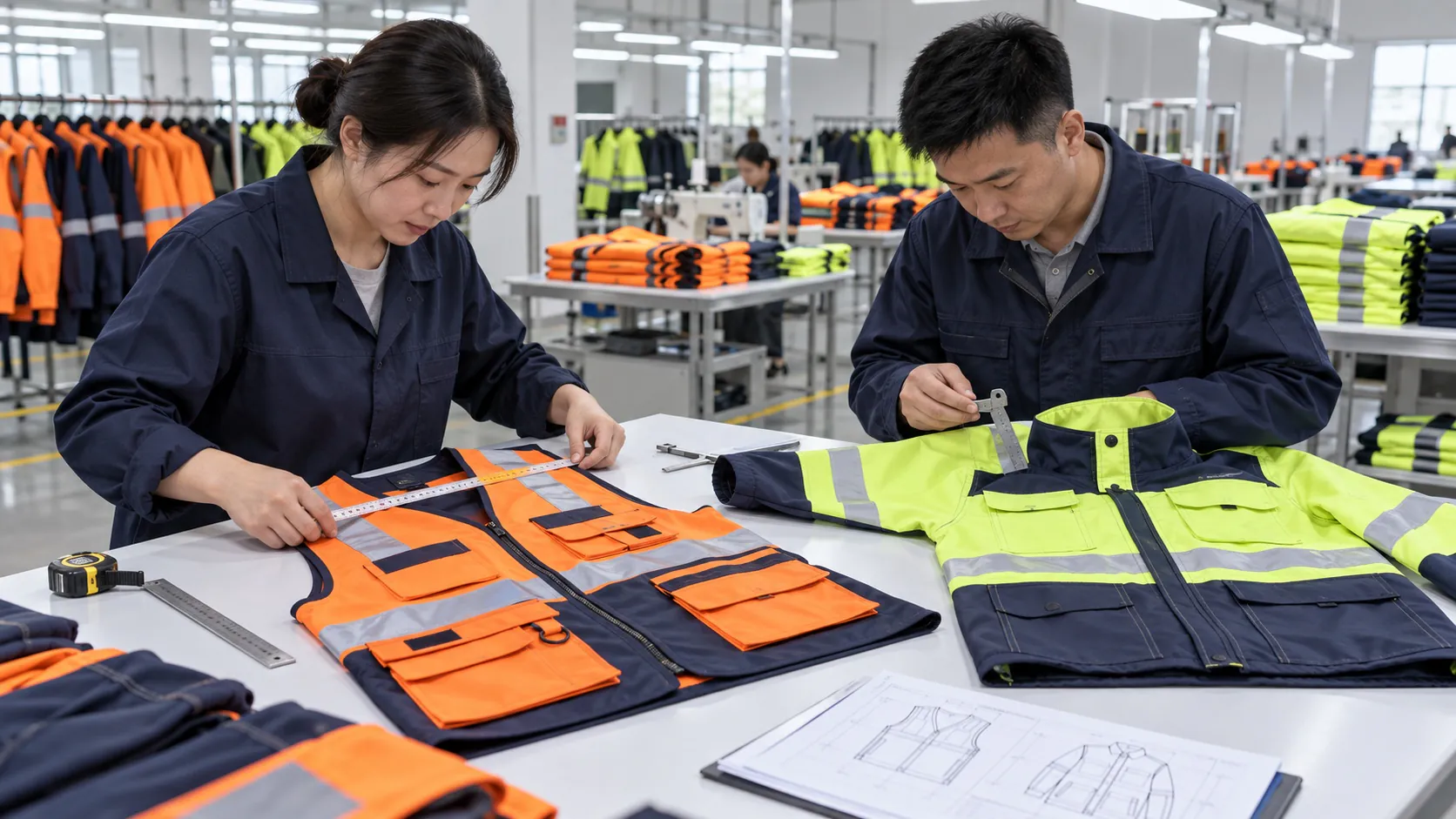
Approve a workwear sample against one written specification, not by eye. Measure it, wear it over real work layers, load the pockets, operate every closure, compare color with the physical standard in daylight-equivalent light, confirm tape and logo placement for the smallest and largest sizes, and check labels and packing. Then record each decision, photograph agreed details and keep the signed sample as the reference for bulk production.
Why approve against a written specification?
A sample is only useful if everyone compares it with the same reference. Before the review, freeze the specification revision: measurements and tolerances, fabric and color targets, tape type and layout, pocket architecture, closures, logo method and placement, labels and packing. Note the target standard and class, if any, so reviewers check the right areas. A digital color preview is a direction only. Production color and any classification are approved on a physical sample, and the signed sample becomes the reference for bulk production and inspection.
Sample approval checklist
Work through each area and record the result in the same document.
| Area | What to check | How to record |
|---|---|---|
| Measurements | Key points vs tolerance | Measurement sheet |
| Fit and layering | Movement over work layers | Wearer notes, photos |
| Fabric and color | Weight, hand, shade vs standard | Signed color comments |
| Reflective tape | Width, placement, continuity | Marked-up photos |
| Construction | Seams, reinforcement, binding | Defect list |
| Pockets and closures | Size, access, operation | Function notes |
| Branding | Method, size, placement, color | Approved artwork version |
| Labels and packing | Content, position, marks | Signed label schedule |
Measure and wear the sample
Measure key points against the specification and its tolerances, then put the garment on real wearers. Wear outer garments over the layers crews use in the coldest season, with harnesses, tool belts or radios where relevant. Reach overhead, kneel, climb into equipment and bend to the ground. Watch for riding up, strain at closures and tape folding out of view. In US construction, OSHA 29 CFR 1926.95(c) requires employers to ensure PPE is selected to properly fit each affected employee, so include different body types and women’s fits in the trial.
How should color be judged?
Compare the sample fabric with the approved physical color standard, such as a lab dip against a Pantone target, under daylight-equivalent light and away from screens. Review fluorescent background, contrast panels, thread, binding, zipper tape and logo colors together. Hi-vis background must be a listed fluorescent color: yellow-green, orange-red or red under ANSI/ISEA 107, and yellow, orange-red or red under EN ISO 20471. A digital brand-color preview does not inherit a high-visibility classification. Write shade comments on the swatch itself, then sign and date it.
Inspect reflective tape and construction
Inspect the sample inside and out, in good light, with the specification open.
- Tape width matches the target standard; EN ISO 20471 bands are at least 50 mm wide.
- Bands line up across seams and closures, and pocket flaps do not cover them.
- Logos and pockets leave the required background and tape visible on the smallest and largest sizes.
- Seams run straight and even, with reinforcement at stress points such as pocket corners.
- Binding, hems and edges lie flat without twisting or puckering.
- Tape stays flat after flexing, with no lifting or cracking at the edges.
Test pockets, closures and hardware
Load every pocket with the items wearers actually carry, such as radios, phones, tablets, tape measures, pens and plans. Check that openings work with gloves on, that loaded pockets do not sag over tape and that flaps close fully. Run each zipper end to end. Open and close snaps and hook-and-loop repeatedly. Pull breakaway points to confirm they release and reattach as designed. Confirm that mic tabs, badge holders and loops sit where the wearer can reach them while working.
Check labels, branding and wash route
Compare every label with the label schedule for content, language, position and print quality. Check logo method, size and color on the garment itself, not on a digital proof. Review hangtags, folding, individual packing and carton marks if they are part of the order. Agree the wash route behind any wash checks: ISO 15797 industrial procedures for garments sent to industrial laundries, or ISO 6330 domestic procedures for home washing. The care label should match that route.
Lock the approval record
Record the decision as approved, approved with comments or resubmit, linked to the specification revision. Attach the measurement sheet, signed color standard, photos of tape, pockets, logos and labels, and a written list of corrections for bulk. Keep signed approved samples with both the buyer and the factory so inspection compares against the same physical reference. Any change to color, material, tape layout, pockets or logo placement means the finished configuration must be reviewed again. Safvero confirms samples and pre-production samples case by case through an inquiry.
Common questions
What is a pre-production sample in garment manufacturing?
A pre-production sample is made with the approved bulk fabric, trims, labels and methods once the design is settled. It confirms that bulk production can reproduce the approved sample before cutting starts. At Safvero, sample and pre-production sample arrangements are confirmed case by case through an inquiry.
How do you approve color on hi-vis workwear?
Compare a physical fabric sample or lab dip with the approved standard under daylight-equivalent light, not on a screen. Check background, trims and logo colors together. A digital preview is a direction only, and a brand color outside the standard’s fluorescent background colors does not inherit a high-visibility classification.
Can I approve a workwear sample from photos?
Photos help with early comments, but final approval should happen on a physical sample. Color, fabric hand, fit, construction and reflective tape cannot be judged reliably on a screen. A digital preview is a direction only; production color and any classification are approved on a physical sample.
Do I need a new sample if I change the color or logo?
Often, yes. Changing color, material, tape layout, pockets or logo placement means the finished configuration must be reviewed again, including any classification. Depending on the change, that review may need a revised sample or a pre-production sample, confirmed case by case through an inquiry.
Sources and further reading
OSHA 29 CFR 1926.95: criteria for personal protective equipmentISEA: PPE fit for allISEA: ANSI/ISEA 107-2020 high-visibility safety apparelISO 20471 overviewEU-OSHA OSHwiki: reflective clothingISO 15797: industrial washing procedures for testing workwearTurn the guide into a product brief.
Choose a product or send the requirement that still needs a recommendation.
Explore workwear