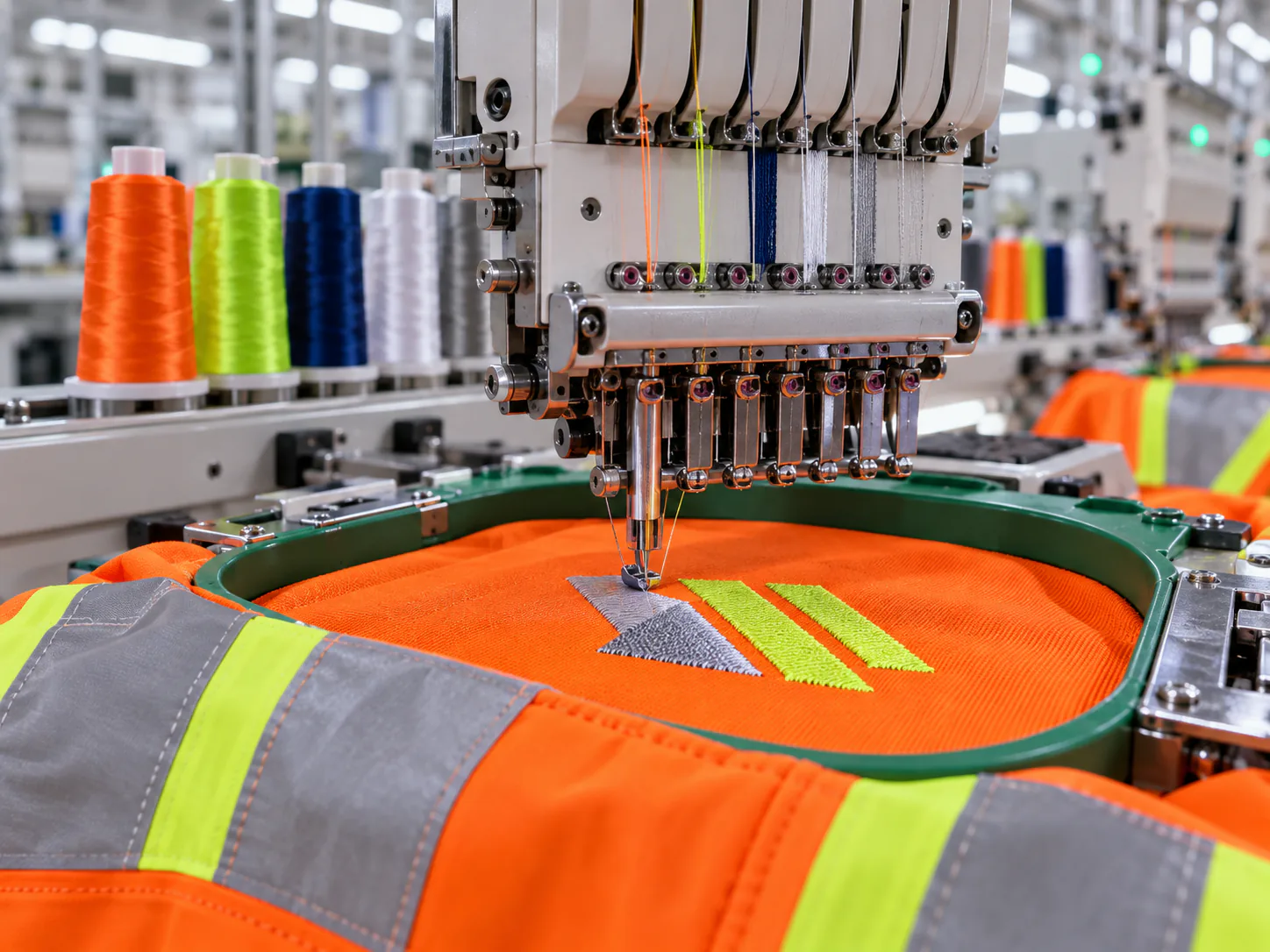
Approve a written label and packing schedule before bulk production. It should list every brand, size and care label, fiber content, country of origin, the standard marking for the target market, hangtags, individual packing, carton assortment and shipping marks. Check each item against the destination market’s rules and the finished, approved garment. High-visibility markings, such as the EN ISO 20471 pictogram or the ANSI/ISEA 107 type and class, belong on the garment label.
What goes into a label schedule?
A label schedule is one controlled list of every label, tag and mark, with content, position and language. Use it to brief, sample and inspect.
| Item | Content | Typical position |
|---|---|---|
| Brand label | Logo or brand name | Neck or back yoke |
| Size label | Size designation | Neck or with care label |
| Fiber and care label | Fiber %, care symbols, origin | Inside side seam |
| Standard marking | Standard, type, class, pictogram | With the care label |
| Hangtag | Style, color, size, barcode | Attached, removable |
| Bag label | Style, color, size, quantity | Outside the polybag |
| Carton marks | Order and packing data | Carton sides |
Required label content by market
Confirm current requirements with the importer for each destination. These are the core items to plan for.
- United States: fiber content by generic name and percentage by weight in descending order, country of origin, and the manufacturer or dealer by company name or FTC RN number.
- United States care: washing or drycleaning instructions on a label that is permanently attached, legible for the garment’s useful life and backed by a reasonable basis.
- European Union: Regulation (EU) No 1007/2011 governs textile fiber names and composition labeling; hi-vis PPE also carries the CE mark and EN ISO 20471 marking.
- Canada: fiber content by generic name and percentage for fibers of 5% or more, and dealer identity by name and postal address or a CA identification number, in English and French.
- Care symbols: ISO 3758 internationally; ASTM D5489 symbols are accepted in the United States.
What does an EN ISO 20471 label show?
For Europe, the label carries the EN ISO 20471 reference, the high-visibility pictogram showing the class and the CE mark. General requirements come from EN ISO 13688, including a size designation based on body measurements such as height and chest girth, shown in a pictogram. The manufacturer also states the maximum number of cleaning cycles the garment withstands without losing performance. Under Regulation (EU) 2016/425, high-visibility clothing is Category II PPE: CE marking follows EU type-examination by a notified body, conformity to type and an EU declaration of conformity.
What does an ANSI/ISEA 107 label show?
In the United States, ANSI/ISEA 107-2020 garment labels identify the standard, the garment type and the performance class, for example Type R Class 2. Class E pants are supplemental items, not compliant on their own; worn with a Class 2 top, they form a Class 3 ensemble. Base the marking text on the documents for the finished configuration and order, never on a fabric or tape certificate alone. If color, material, tape layout, pockets or logo placement change, the finished configuration and its label must be reviewed again.
Private-label branding to supply
For private label, send brand label artwork with size, colors, fold type and method, such as woven or printed, plus hangtag artwork, barcode numbers and any retail copy. Printed or heat-transfer neck labels are softer against the skin than stiff woven labels, which matters on shirts worn all shift. Keep claims on hangtags and packaging consistent with the finished configuration. A hangtag should not state a class or standard that the order’s documents do not support. Labels, hangtags and packing are part of Safvero’s customization routes.
Packing and carton-mark checklist
Define packing before the pre-production sample so it can be checked with the garment.
- Fold method and folded size, with any insert or tissue.
- Individual polybag, closure and any printed warning the importer requires.
- Bag label showing style, color, size and quantity.
- Carton assortment: a single size per carton or an agreed size ratio.
- Shipping marks: purchase order, style, color, size breakdown, quantity per carton and carton number.
- Gross and net weight, carton dimensions and country of origin on every carton.
Keep label information accurate
Care, composition, origin and product claims must match the finished item, not the development sample. A change of shell fabric, lining, tape or trim can change fiber content and care instructions, so update the schedule with each specification revision. In the United States, care instructions need a reasonable basis. For EN ISO 20471 garments, align the care label with the cleaning route behind the stated maximum number of cleaning cycles. Approve labels on the pre-production sample and check that they stay legible after washing. Safvero confirms samples and pre-production samples case by case through an inquiry.
Common questions
What information must be on a clothing label in the US?
US textile labels show fiber content by generic name and percentage by weight in descending order, the country of origin, and the manufacturer or dealer identity by company name or FTC RN number. Garments also need a permanent, legible care label with washing or drycleaning instructions that have a reasonable basis.
Do clothing labels in Canada need English and French?
Yes. Canadian textile labels show fiber content by generic name and percentage for fibers of 5% or more, plus dealer identity by name and postal address or a CA identification number, in English and French. Confirm the final wording with the importer before labels are produced.
Where does the CE mark go on high-visibility clothing?
On the garment label, with the EN ISO 20471 reference and the high-visibility pictogram showing the class. Under Regulation (EU) 2016/425, high-visibility clothing is Category II PPE, so CE marking follows EU type-examination by a notified body. Packaging marks do not replace the garment label.
What should export carton shipping marks include?
Agree the marks with the importer. Typical shipping marks show the purchase order, style, color, size breakdown, quantity per carton, carton number, gross and net weight, carton dimensions and country of origin. Mark every carton the same way so receiving teams can check counts without opening cartons.
Sources and further reading
FTC: labeling requirements under the Textile and Wool ActsFTC: complying with the Care Labeling RuleRegulation (EU) No 1007/2011 on textile fibre names and labellingCompetition Bureau Canada: textile labelling regulationsRegulation (EU) 2016/425 on personal protective equipmentISO 20471 overviewEU-OSHA OSHwiki: reflective clothingISEA: ANSI/ISEA 107-2020 high-visibility safety apparelTurn the guide into a product brief.
Choose a product or send the requirement that still needs a recommendation.
Explore workwear